
 book a call with us
BNB keeps the on-chain work smooth, though the backend is where the complexity really starts to appear. The moment you need your dApp to react, to trigger a workflow, call an API, or send a transaction – everything slows down. You end up juggling scripts, maintaining servers, and babysitting cron jobs that keep breaking. What if your backend could listen to every BNB event, […]
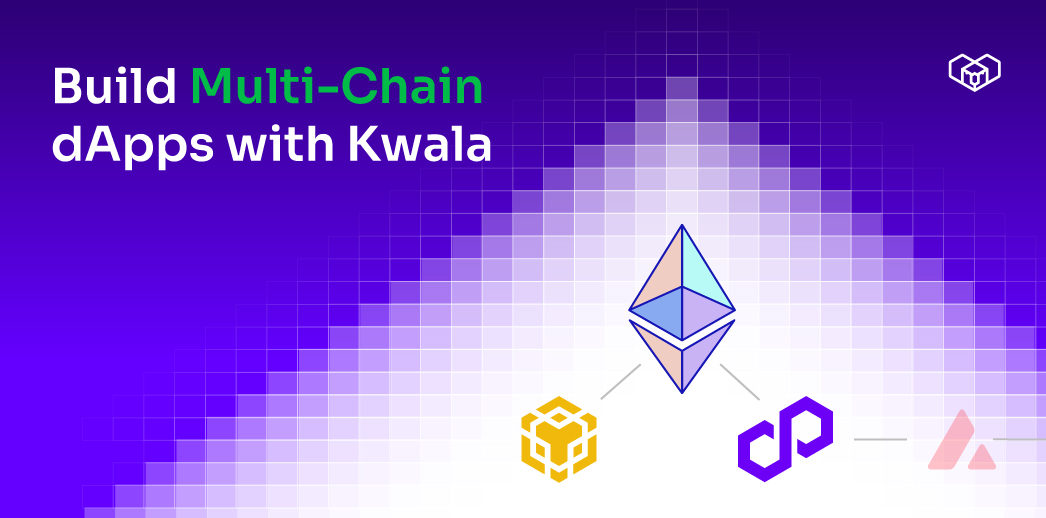
Read MoreTo build multi-chain dApps is to deploy your application across multiple EVM-compatible blockchains — Ethereum, Polygon, Avalanche, Base, Optimism, BNB Chain, Celo, and others — to reach more users, reduce gas costs, and avoid single-chain dependency. The hard part isn’t writing the contracts. The hard part is keeping the off-chain logic consistent across every chain you support, without operating a different backend for each one. Kwala solves that by letting you define a workflow once and run it across every chain you care about, no per-chain code required.
This guide is the entry point for builders evaluating multi-chain development architecture, plus a navigation hub for the chain-specific deep dives below.
Key Takeaways
- Single-chain dApps are now the exception. Over 65% of new smart contracts in 2025 deployed to Layer-2 networks rather than Ethereum mainnet, and most production dApps are multi-chain by default.
- The hard part isn’t the contracts — it’s the off-chain layer. Smart contracts can be deployed to multiple chains through deterministic deployment patterns. The orchestration logic that ties them together is where teams get stuck.
- Most multi-chain tooling solves connectivity, not coordination. RPC providers and indexers cover one piece each. The workflow layer that decides what should happen on which chain, and when, usually ends up as custom backend code.
- Kwala is built around a single principle: declare your intent once, execute everywhere. A workflow that lists multiple networks runs across all of them, with chain-specific configuration handled at the platform level.
- The right chain depends on user base, gas economics, and ecosystem fit — not on what your tooling supports. This guide includes deep dives on six major EVM chains so you can pick based on the architecture decision, not the integration burden.
Why Build Multi-Chain? The Case for EVM Portability
A few years ago, multi-chain development was an optimization most teams deferred. Build on Ethereum first, prove the product, expand later. That order has changed. The economics, the user distribution, and the infrastructure maturity have all shifted enough that a serious dApp launching in 2026 typically needs to think about cross-chain EVM support from week one.
Four reasons drive this shift:
Broader user reach.
Different chains have different user bases. BNB Chain dominates user count in Asia. Base is the fastest path to Coinbase’s customer base. Polygon dApp development anchors the largest non-Ethereum DeFi ecosystem. Avalanche dApp builders get institutional and gaming traction. Picking one chain means accepting that you’ve cut off most users.
Gas cost optimization.
Mainnet Ethereum gas is fine for a $100,000 institutional transaction and prohibitive for a $5 user mint. Per recent L2 fee comparisons, the same on-chain action that costs $50 on Ethereum costs roughly $0.01 on Base or Polygon. Consumer-facing dApps that ignore the gas differential price themselves out of their own market.
Resilience.
A chain having a bad day shouldn’t take your application down. Single-chain dApps inherit every operational risk of their host chain — RPC outages, fee spikes, network upgrades, validator issues. Multi-chain dApps can route around problems, with the trade-off that the orchestration layer must handle that routing.
L2 scaling.
Most of the chains in this guide are Layer-2 rollups built on Ethereum’s security model. Per The Block’s 2026 L2 Outlook, Base, Arbitrum, and Optimism collectively process roughly 90% of all L2 transactions, and L2s now host most new application deployments. A dApp shipping only on L1 is leaving most of its potential throughput on the table.
The case for multi-chain is straightforward. The execution is where teams get stuck — which is what the next section is about.
How Kwala Makes Multi-Chain Development Simple
The standard multi-chain architecture pattern, built without specialized tooling, requires teams to:
- Deploy contracts to each chain you want to support, usually using deterministic deployment so addresses match across chains.
- Set up RPC connectivity to each chain through one or more providers, with failover handling.
- Write event listeners for each chain, with chain-specific retry and finality logic.
- Build orchestration code that decides, when an event fires on chain A, whether and how to act on chain B.
- Maintain all of that, on a per-chain basis, every time you add a new chain.
The mental model required is closer to running distributed infrastructure than to writing application code. Most of the complexity sits in the orchestration layer, not in the contracts themselves.
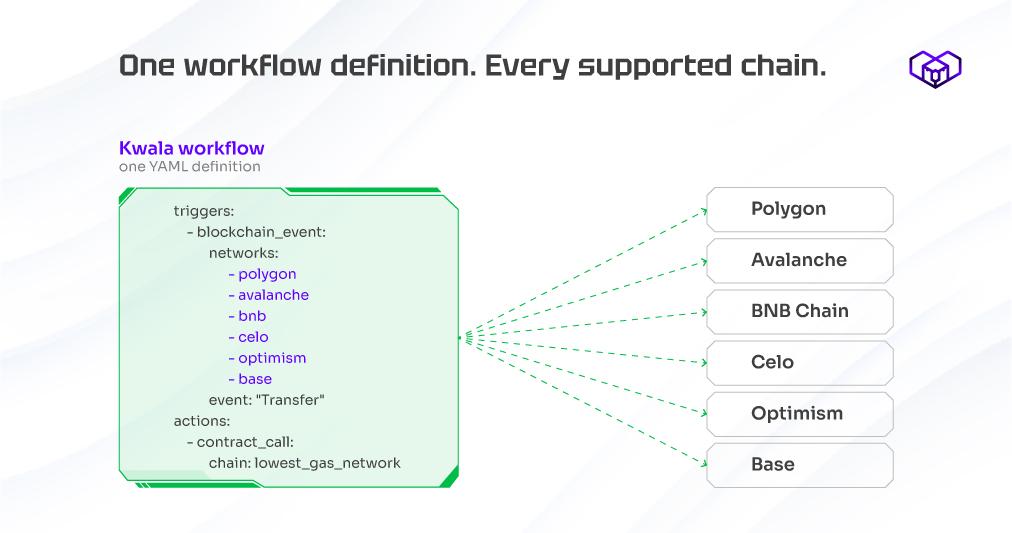
Kwala’s approach inverts this. Instead of writing chain-specific code that handles cross-chain coordination, you define a single workflow that declares which chains it should run on. The model has three properties worth naming:
- One workflow, many networks. A trigger can list multiple networks. The platform handles per-chain RPC connections, event filtering, and state coordination automatically.
- Chain-aware actions. An action can specify a single chain, all chains, or dynamic routing like “execute on whichever chain has the lowest gas at runtime.”
- No per-chain code. Adding a new chain to an existing workflow is a configuration change, not a code rewrite. Chain support lives in the platform, not in your application.
A simplified Kwala workflow that monitors three chains and acts on the cheapest one looks roughly like:
name: cross-chain-trigger
triggers:
– blockchain_event:
networks: [ethereum, polygon, arbitrum]
contract_address: “0x…”
event: “Transfer”
actions:
– contract_call:
chain: lowest_gas_network
function: “processTransfer”
params: [“{event.params}”]
This workflow listens for a Transfer event on three chains simultaneously and routes the response to whichever chain has the lowest gas at execution time. The workflow author writes one file. Kwala handles the per-chain RPC connections, the event filtering, the gas calculation, and the action routing.
The shorthand: build once, deploy on multiple blockchains without rewriting anything. For a deeper look at Kwala’s chain support, see the supported chains documentation.
Supported EVM Chains — Deep Dives
Six EVM chains where Kwala has deep ecosystem support. Each has its own technical positioning, its own user base, and its own canonical use cases. The summary below points to the right deep dive for your evaluation.
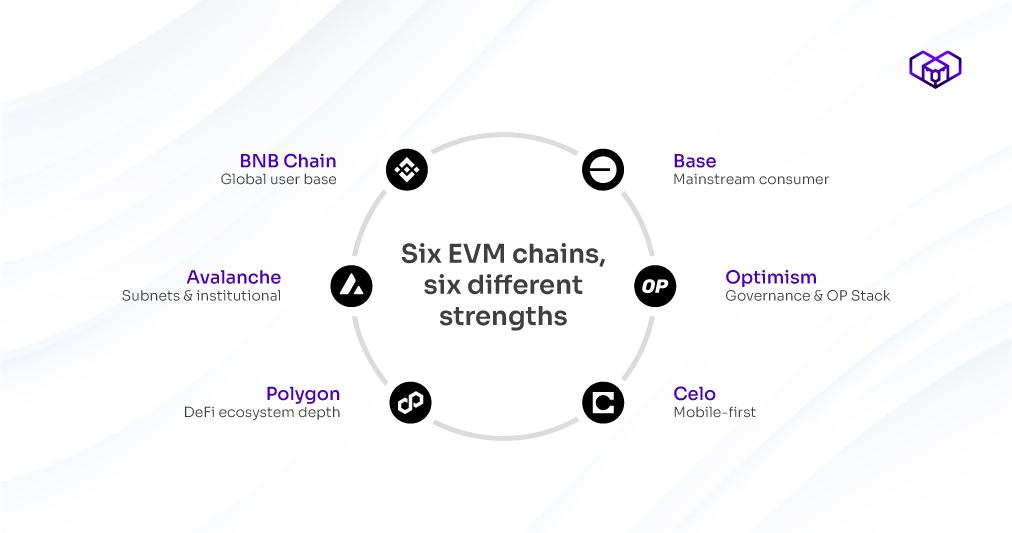
- Polygon — The largest non-Ethereum DeFi ecosystem. PoS chain plus a zkEVM, gas costs typically around $0.01 per transaction, native integration with Polygon ID for on-chain identity. The right chain if you’re building DeFi or any product where ecosystem depth matters more than chain branding. Common Kwala pattern: automated yield farming workflows on Aave Polygon.
- Avalanche — Subnet architecture lets you deploy purpose-built application chains, with the C-Chain handling general EVM workloads. Sub-second finality and Avalanche Warp Messaging for cross-subnet coordination. The right chain for institutional-grade applications and games that need their own execution environment. Common Kwala pattern: cross-subnet workflow automation.
- BNB Chain — The largest user base globally, especially across Asia. BEP-20 token standard mirrors ERC-20 closely, transaction fees are consistently low, and opBNB extends the chain into L2 territory. The right chain for high-volume consumer applications, gaming, and social products where user count matters. Common Kwala pattern: high-volume payment automation for gaming and social apps.
- Celo — Mobile-first blockchain with native phone-number-to-address mapping, stablecoin-native architecture (cUSD, cEUR), and a strong ReFi (regenerative finance) ecosystem. The right chain for mobile-first products targeting users who don’t already hold crypto wallets. Common Kwala pattern: mobile payment notification workflows.
- Build on Optimism — OP Stack is the framework powering Base and a growing list of L2s under the Superchain vision. Bedrock upgrade improved finality and reduced costs significantly. Strong governance culture, retroactive public goods funding model. The right chain if you’re building governance tools, public goods infrastructure, or want to position for the broader OP Stack ecosystem. Common Kwala pattern: governance alert and auto-delegation workflows.
- Base chain development — Coinbase’s L2, built on the OP Stack. Direct fiat on-ramp integration, mainstream user onboarding flows, and per The Block’s analysis, the dominant L2 of 2025 by TVL share, transaction volume, and user growth. The right chain for consumer applications targeting US users and anyone optimizing for the path from credit card to on-chain. Common Kwala pattern: consumer app notification and payment flows.
The deep dives cover what makes each chain different — gas economics, ecosystem maturity, technical idiosyncrasies, and the specific patterns that work well with Kwala’s workflow model. Read the one (or two) that match your project; skip the rest.
Multi-Chain Architecture Best Practices
Whatever tooling you use, four architectural patterns matter for multi-chain dApps. Getting them right early is much easier than retrofitting them later.
- Deterministic deployment. Use CREATE2 or similar deterministic deployment so your contracts have the same address across all chains you deploy to. Same-address deployment dramatically simplifies your frontend (one address everywhere), your documentation, and your debugging. Without it, every cross-chain reference in your application has to handle chain-specific address mapping.
- RPC management. Use multiple RPC providers per chain, with automatic failover. Public RPCs throttle under load. Single-provider setups have one failure mode that takes your entire application down. Production multi-chain dApps typically use a managed RPC provider like Alchemy, Infura, or QuickNode plus a fallback.
- Cross-chain data layer. Application state that spans chains needs a single source of truth. The naive pattern (read state from each chain on demand) breaks under load and produces inconsistent UX. Better patterns: an indexer like The Graph that aggregates events across chains, or a workflow-based pattern where Kwala writes derived state to a single chain for application reads.
- Gas optimization per chain. Don’t run the same logic at the same priority on every chain. Mainnet Ethereum operations should be infrequent, batched, and gas-aware. L2 operations can be more granular. Multi-chain workflows that ignore the gas cost differential end up paying mainnet prices for transactions that should have run on an L2.
For the underlying architecture model and how Kwala handles these patterns at the platform level, see the system overview documentation.
FAQs: Multi-Chain dApp Development
What is the cheapest EVM chain for dApp deployment?
The cheapest mainstream EVM chains are typically the L2s — Base, Optimism, Arbitrum, and Polygon zkEVM all run transactions for fractions of a cent. BNB Chain’s L1 and Polygon PoS are also consistently cheap. Mainnet Ethereum is the most expensive by an order of magnitude. The honest framing: “cheapest” depends on your transaction volume and what kind of operations you’re running. A dApp making thousands of small writes will pick differently than one making infrequent large transfers. Pick based on your workload, not on the headline gas price.
Can I deploy the same smart contract on multiple chains?
Yes — and you should, if you want a single user experience across chains. The standard approach is deterministic deployment using CREATE2 or a deployer contract pattern, which lets you deploy to the same address on every chain. Tools like Axelar’s Create2Deployer or OpenZeppelin’s deployment libraries handle this. Once deployed, your contract logic is identical across chains, and the only chain-specific concern becomes how off-chain systems coordinate between them — which is the multi-chain orchestration problem this guide is about.
How does Kwala handle cross-chain workflows?
Cross-chain in Kwala is part of the workflow definition, not a separate system. A single workflow can list multiple networks in its trigger configuration, and actions can specify which chain they execute on — including dynamic routing like “execute on whichever chain has the lowest gas right now.” The platform handles per-chain RPC connections, event filtering, and execution coordination. From the developer’s perspective, multi-chain workflows look the same as single-chain workflows, just with more networks listed. There’s no separate cross-chain bridge product to integrate with, and no chain-specific code to maintain.