
 book a call with us
You know that moment when you’re refreshing a blockchain explorer and look away for just one minute? That’s usually when the block you’ve been waiting for gets mined. It often leads to missed rewards, failed bids, or poorly timed actions. That’s the reality of Web3, where everything happens instantly on-chain with zero patience for human timing. Tracking block numbers manually, checking explorers, or […]
Read MoreEighteen months ago, the standard EVM backend stack was a collection of custom scripts, polling loops, and monitoring dashboards that required constant maintenance. In 2026, that approach is a competitive liability. Here is what replaced it — and why the gap between teams that automated early and teams that didn’t is widening every quarter.
According to Mordor Intelligence, the global smart contracts market is projected to grow from approximately $2.6 billion in 2025 to $24.67 billion by 2034, driven primarily by automation adoption across DeFi, supply chain, and enterprise blockchain applications. But here is what that number does not tell you: much of this growth is coming from teams replacing manual transaction management with systems that react to on-chain events without human intervention. Web3 automation is becoming the operational backbone for serious EVM-based applications.
Here is what that shift looks like in practice, and why it matters for the applications you are building.
Why EVM Developers Are Rethinking Backend Operations in 2026
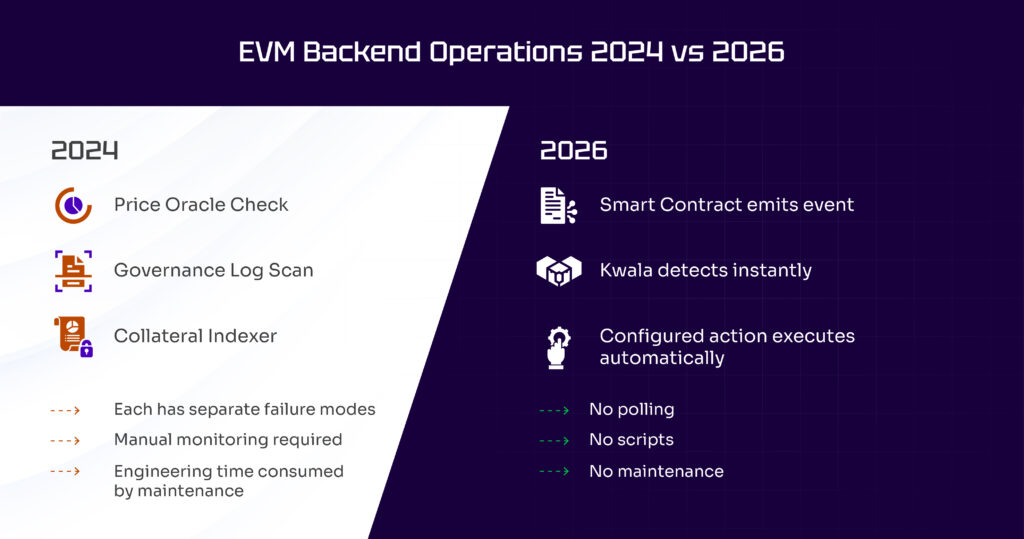
The traditional approach to EVM development treated the backend as an afterthought. You wrote your contracts, deployed them, and then cobbled together scripts to monitor what happened next. This created a constant maintenance burden that pulled engineering time away from product development.
In practice, this meant maintaining three separate polling loops running simultaneously one checking a Chainlink oracle on a 30-second interval, one watching governance contract logs with eth_getLogs, one monitoring user collateral positions via custom indexing. Each loop had its own failure mode. When the oracle polling script missed an update during high network congestion, the liquidation logic did not fire. When eth_getLogs hit rate limits on public RPC endpoints, governance events were dropped silently. When the indexer fell behind on block sync, collateral positions showed stale data.
None of these failures were visible until a user reported a problem or a position liquidated incorrectly. The operational cost was not the scripts themselves it was the invisible failure surface they created.
According to Chainalysis’ 2025 Crypto Crime Report, DeFi hacks via faulty smart contracts caused over $2.1 billion in losses in 2024 alone, highlighting how fragile these manual systems can become under production conditions. The shift toward EVM workflows that handle this complexity automatically is not about convenience. It is about building systems that actually scale and that fail visibly rather than silently.
This is where platforms like Kwala enter the picture. Rather than maintaining custom monitoring infrastructure, teams define the on-chain events that matter to their protocol, configure the appropriate responses, and let an event-driven execution layer handle the rest. The monitoring reliability problem doesn’t go away it moves from your engineering backlog to Kwala’s infrastructure layer.
Event-Driven Architecture Is Now the EVM Standard
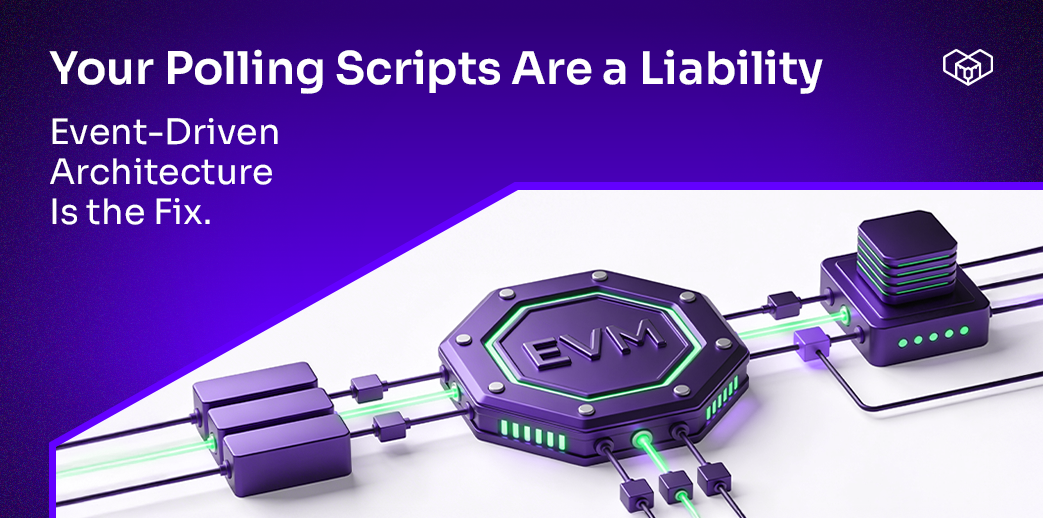
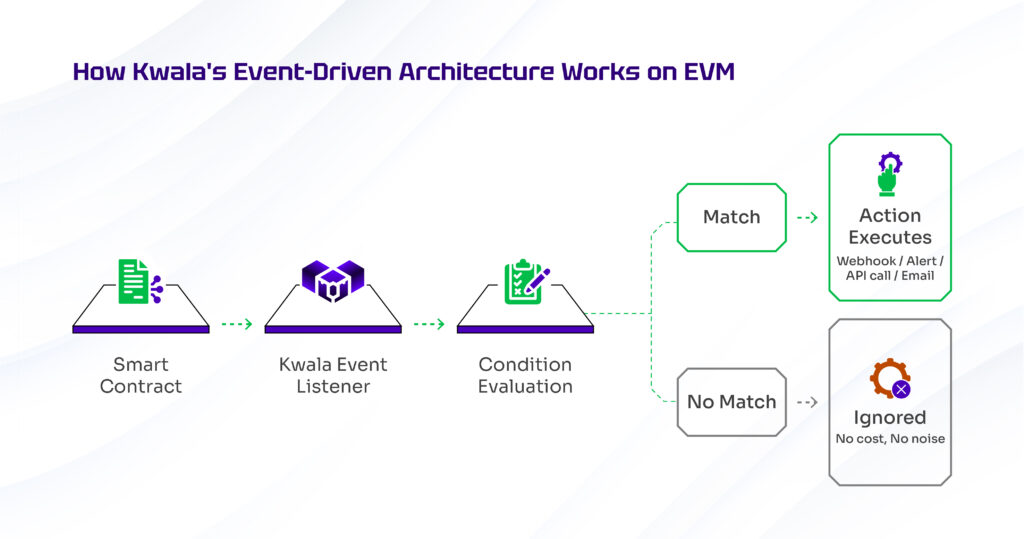
Among Web3 automation trends in 2026, none is more foundational than the shift to event-driven architecture. Instead of polling contracts or running scheduled checks, modern systems respond directly to on-chain events the moment they occur.
What does this mean practically? When your smart contract emits a Transfer event or your governance proposal reaches a voting threshold, the automation layer detects that instantly and executes the appropriate response. There is no lag, no missed signals, and no wasted compute resources checking for changes that have not happened.
The $2.1 billion in 2024 DeFi losses was not purely a smart contract vulnerability problem it was partly an operational monitoring failure. Many of those exploits had on-chain signatures before the damage was complete: unusual transaction patterns, abnormal function call sequences, wallet interactions that deviated from normal usage. Event-driven monitoring with precisely configured triggers can detect these signatures in real time and alert security teams before losses compound.
Kwala’s event trigger system addresses this directly by giving teams the ability to define precise monitoring conditions not just “watch this contract” but “alert me when this specific event fires with these specific parameters from this wallet category.” The precision of the trigger determines the quality of the signal. Broad monitoring produces noise. Precise event-driven monitoring produces actionable intelligence.
Understanding how blockchain events trigger automated actions is the foundation for this approach and for EVM teams specifically, it means replacing polling loops and eth_getLogs scripts with a single event-driven configuration layer that handles uptime, scaling, and delivery reliability without your team managing the underlying infrastructure.
Cross-Chain Orchestration: Managing Multi-Network EVM Workflows
Another defining characteristic of blockchain automation in 2026 is the expectation that workflows will span multiple chains. The days of building exclusively for Ethereum mainnet are fading as teams deploy across Base, Polygon, Avalanche, and other EVM-compatible networks.
This creates a real coordination challenge. How do you ensure that an action on one chain triggers the appropriate response on another? Manual approaches fall apart quickly when you are managing:
- Treasury operations distributed across multiple networks
- User activity that spans different chains and bridges
- Protocol governance with multi-chain token holders
- Liquidity management across decentralized exchanges on different networks
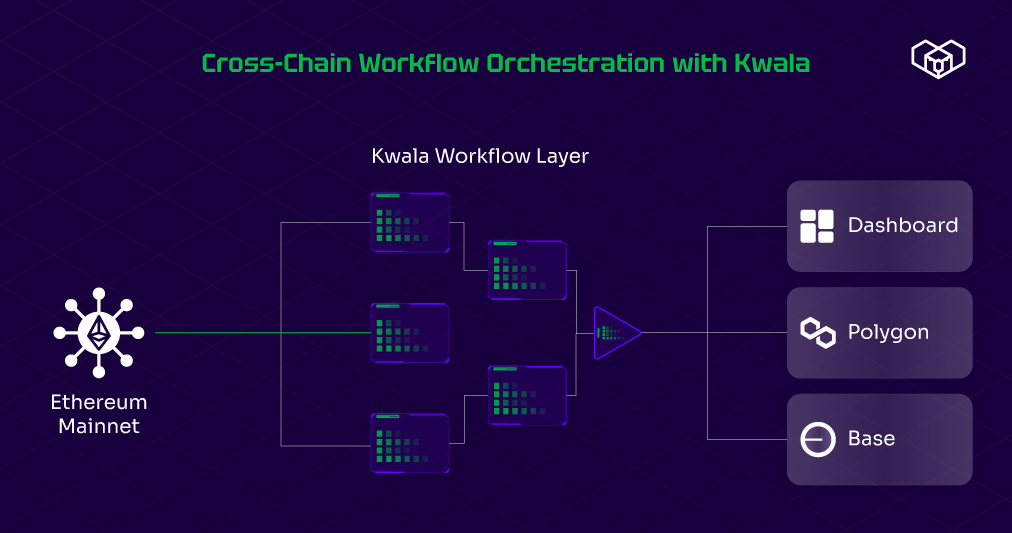
A practical example illustrates the scope of the problem: your protocol has governance token holders on Ethereum mainnet and liquidity deployed on Base and Polygon. A governance proposal reaches quorum on mainnet. That single event should simultaneously update your governance dashboard, notify token holders across all three chains, and pause new liquidity additions on Base and Polygon pending the proposal outcome. Without cross-chain orchestration, this requires three separate monitoring setups with manual coordination between them, each with its own failure modes and maintenance burden.
Kwala supports building workflows across multiple EVM-compatible chains, allowing teams to monitor events on one network and route configured actions across your operational stack without maintaining separate infrastructure per chain. Each workflow is scoped to a single contract for precision, but you deploy parallel workflows per network with outputs routing to unified dashboards one operational view regardless of chain count. Learn more about Kwala’s multi-chain workflow support .
How AI Integration Is Reshaping Smart Contract Interactions
The fusion of AI with smart contract automation represents one of the most practical shifts happening in EVM development right now. AI-enhanced systems can adjust lending terms based on real-time risk analysis, optimize trading strategies based on market conditions, and detect anomalies before they become exploits.
The most advanced DeFi protocols are beginning to deploy AI for:
- Dynamically adjusting collateral requirements based on borrower behavior and market volatility
- Routing transactions through optimal liquidity paths by analyzing real-time depth across DEX pools
- Identifying suspicious activity patterns that precede attacks abnormal call sequences, unusual volume spikes, coordinated wallet activity
- Automating governance analysis for proposal voting based on protocol impact modeling
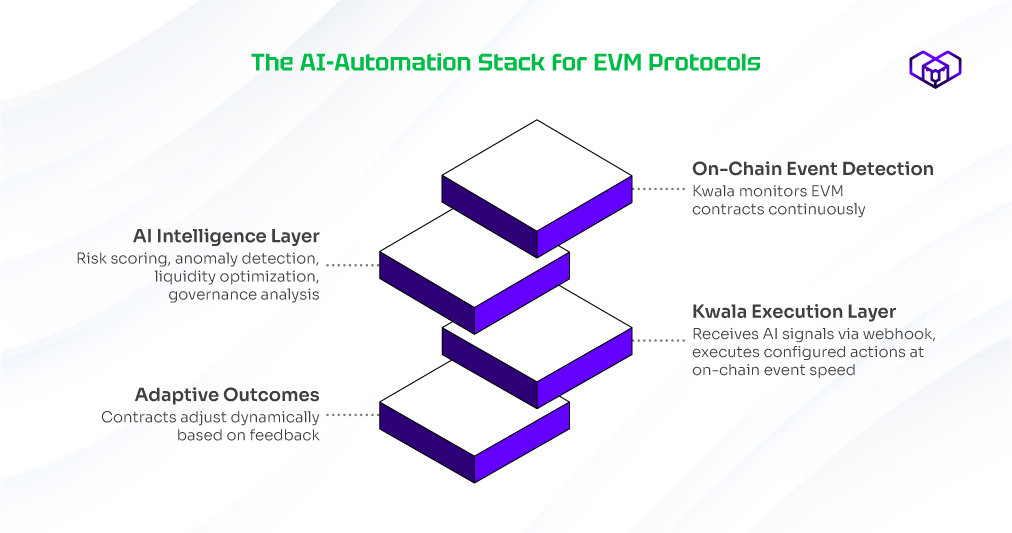
The key insight for your architecture is that AI provides the intelligence layer while automation provides the execution layer. When these work together, contracts become adaptive rather than static.
Kwala’s role in this stack is the execution and delivery layer. When an AI model identifies a high-risk transaction pattern, Kwala is the system that receives that signal via API webhook and immediately routes the appropriate response pausing a user’s position, alerting a compliance team, or updating a risk dashboard without requiring manual handoff between the AI detection layer and the operational response. The AI provides the intelligence. Kwala provides the reliable execution that makes that intelligence actionable at the speed of on-chain events.
Teams building automated DeFi workflows with Kwala are discovering that pairing precise event triggers with AI-generated decision signals creates systems that respond to complex conditions without requiring manual classification at every step.
Applying EVM Automation Trends to Your Development Stack Today
Understanding these trends is one thing. Applying them starts with a specific audit of your current EVM monitoring setup.
Are you running The Graph subgraphs that require manual reindexing when contracts upgrade? Do you have custom Node.js scripts polling eth_getLogs on a schedule? Are team members checking Etherscan for transaction confirmations manually? Each of these is an automation candidate. The move from polling to event-driven detection eliminates the latency, the maintenance burden, and the failure points that polling-based systems introduce by design.
A concrete starting point: for each monitoring script in your current stack, ask two questions what event am I actually waiting for, and what do I do when I detect it? The answer to those two questions is your first Kwala workflow: an event trigger on the contract event you are polling for, and a configured action that performs what you currently do manually when you detect it.
Most EVM teams find five to eight automation candidates in their first audit. Start with the highest-frequency manual check the one that happens most often and produces the most predictable response. That workflow proves the pattern. From there, expanding to additional events, additional chains, and more complex conditional logic follows the same Kwala configuration structure without requiring new infrastructure.
Next, consider which events actually matter for your protocol. Not every on-chain activity requires a response, but the ones that do should trigger immediate action. Kwala’s approach to real-time event monitoring helps teams focus on signals rather than noise precise trigger conditions mean your team only sees what requires attention, not everything the chain is doing.
Finally, think about how your workflows will span multiple chains as your protocol grows. Building with cross-chain orchestration in mind from the start prevents the architectural rework that comes from bolting on multi-network support later. The EVM automation landscape has matured from experimental tooling to production-ready infrastructure. The trend is clear, and the tooling is ready.
Start Automating Your EVM Stack With Kwala
The teams building durable EVM applications in 2026 are not necessarily the teams with the largest engineering headcount. They are the teams that identified their highest-cost manual processes, replaced them with event-driven workflows, and built the operational foundation that scales with their protocol rather than against it.
Kwala provides the event-driven automation layer that makes this transition accessible without rebuilding your backend from scratch. Define your contract events. Configure your actions. Let the platform handle monitoring, execution, and delivery across every EVM chain you support. Start building your first EVM workflow with Kwala
Frequently Asked Questions: EVM Workflow Automation in 2026
Does workflow automation work across all EVM-compatible chains?
Most automation platforms support major EVM chains, including Ethereum, Polygon, Base, Avalanche, and BNB Chain. Kwala’s event triggers work across these networks, though each workflow monitors events from a single contract at a time. For multi-chain protocols, deploy parallel workflows per chain with outputs routing to unified dashboards for a single operational view.
How Does EVM Workflow Automation Affect Gas Costs?
Automation itself does not increase on-chain gas costs since monitoring and event detection happen entirely off-chain. You only pay gas when your workflow executes an actual on-chain transaction. For most notification and API-routing workflows, there are no on-chain transactions at all making automated monitoring significantly more cost-efficient than running continuous polling scripts against paid RPC endpoints.
Can I test automated workflows before deploying to mainnet?
Yes. Configure and test your Kwala workflows against contracts deployed on testnets before moving to production. This lets you verify that event triggers fire correctly and that actions execute as expected including webhook delivery, API calls, and notification routing without risking real assets. Most teams complete testnet validation within a day before deploying workflows to mainnet.