
 book a call with us
When your app depends on fast user actions, manual bounty payouts can feel painfully slow. Teams often find themselves tracking every event, checking every wallet, and approving every reward – work that becomes chaotic the moment users interact frequently. These delays don’t just add operational load; they interrupt the real-time experience that players and community members expect. One […]
Read MoreA contract sits on Ethereum, doing nothing until someone pokes it. That has always been the fundamental limitation of blockchain development.
Your code might be brilliant, your logic flawless, but without an external transaction to wake it up, nothing happens.
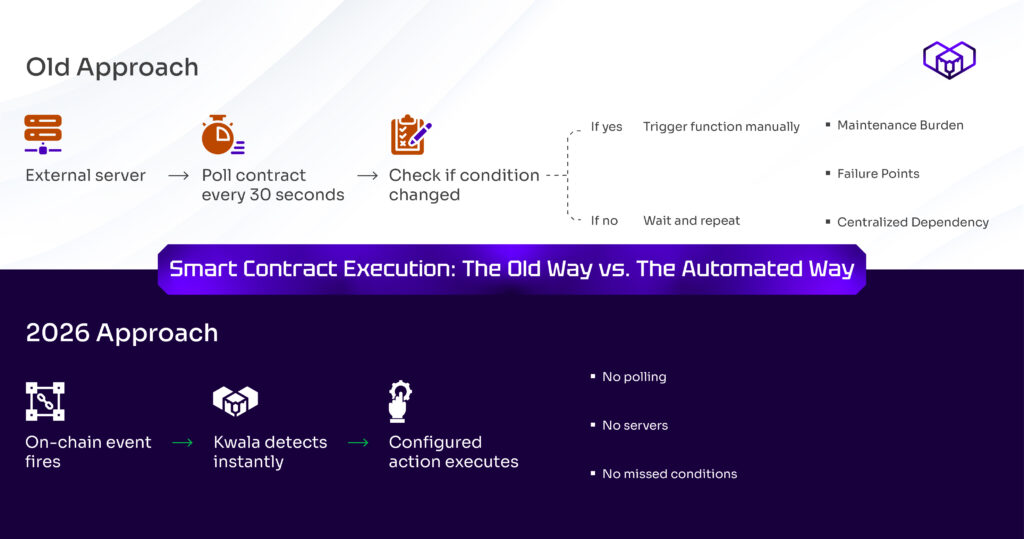
For years, this meant building elaborate workarounds. Developers ran servers that polled contracts every few seconds, checking whether conditions had changed. They hired DevOps teams to maintain scripts that triggered functions when specific thresholds were crossed.
The smart part of smart contracts stopped at the chain boundary, and everything beyond that required manual infrastructure.
But what if contracts could respond automatically? What if the moment a price moved, a balance changed, or a deadline passed, your application simply handled it?
That is exactly where smart contract automation is heading in 2026, and the patterns emerging on EVM chains are reshaping how developers think about building decentralized applications.
Why Smart Contract Automation Became Essential for EVM Development
Have you ever tried explaining to a non-technical stakeholder why your DeFi protocol needs a dedicated server running 24/7 just to check if prices changed? The conversation usually ends with confused looks and pointed questions about why blockchain is supposed to be decentralized if it depends on centralized infrastructure running somewhere in AWS.
This tension drove the push toward better automation and the scale of what’s at stake makes the urgency concrete. According to DeFiLlama – TVL Dashboard, DeFi TVL surpassed $89 billion in 2025, and the operational complexity of managing that much value manually became unsustainable. A protocol managing billions in user funds cannot afford a monitoring script that silently fails during a market event.
EVM applications running on Ethereum, Polygon, Base, and other compatible networks now rely on event triggers as their primary automation mechanism. Instead of asking whether something happened, these systems wait until it does, then execute the appropriate response instantly, reliably, and without human intervention.
The shift also resolves the decentralization contradiction. When your automation layer runs on a distributed execution network rather than a centralized server, your protocol’s responsiveness is no longer dependent on a single infrastructure provider staying online. That architectural alignment between your on-chain logic and your off-chain execution layer matters both for operational reliability and for the trust story you tell your users.
Kwala is built on this principle. Understanding how on-chain events trigger automated actions is the foundation for every pattern described in this article and Kwala’s decentralized execution network means the monitoring layer that connects those events to your workflows carries no single point of failure.
Event-Based Triggers Are Replacing Scheduled Polling
The most significant trend in smart contract automation centers on event-driven architecture. When your contract emits an event whether that is a Transfer, an Approval, a LiquidationCall, or a custom event you defined automation systems detect that instantly and fire your configured response.
The difference from polling is fundamental, not incremental:
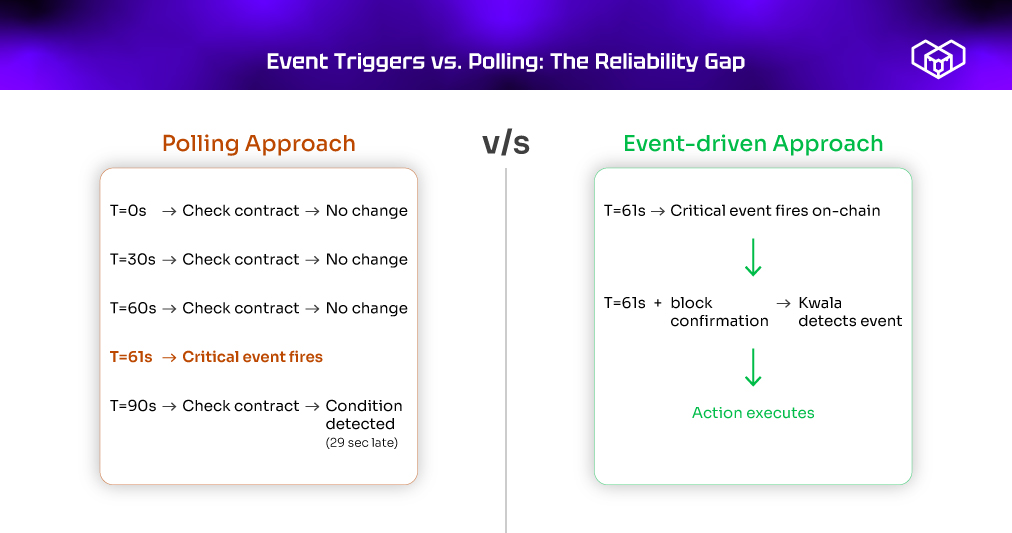
- Polling checks every 30 seconds whether something changed, wasting 99% of those checks on negative results and still potentially missing events that occur and resolve between checks
- Event triggers wait silently until something actually happens, then respond in the same block confirmation window with no gap between the condition becoming true and your system noticing
For applications where timing matters liquidation protection, arbitrage execution, compliance threshold monitoring, governance deadline enforcement that gap is not a minor inefficiency. It is the difference between the system working and the system failing when it matters most.
Kwala uses event triggers to connect on-chain activity with off-chain responses across EVM chains. You define which contract events matter to your protocol, configure what happens when they fire webhook calls, API requests, Telegram notifications, email alerts, or custom endpoint delivery and the platform handles continuous monitoring without your team running or maintaining the underlying infrastructure.
The same event trigger pattern that powers deployment notifications for dev teams extends directly to production protocol operations. Developers who have built automated alerts for blockchain activities find that expanding from notification workflows to full operational automation follows the same configuration structure no new infrastructure required.
Time-Based Automation Fills Critical Gaps in EVM Workflows
Not everything in Web3 responds to events. Some operations need to happen at specific times regardless of what else is occurring on-chain. Governance votes that close at midnight, subscription renewals that process monthly, treasury distributions that execute weekly, and oracle price refreshes that run every hour all require time-based triggers rather than event detection.
This is the second pillar of smart contract automation and it is where many protocols still operate manually, relying on team members to remember to execute functions on schedule.
Recurring Protocol Operations
Protocols increasingly automate recurring tasks that previously required someone to manually initiate execution. Treasury management workflows, staking reward distributions, and periodic portfolio rebalancing all benefit from scheduled automation.
The operational risk of manual execution is underappreciated until something goes wrong. A reward distribution that fires twelve hours late because the responsible engineer was traveling is not just an operational inconvenience it erodes user trust in the protocol’s reliability. Scheduled automation eliminates execution dependency on any individual team member and gives users the predictability they expect from production infrastructure.
Kwala’s time-based workflow configuration allows teams to define recurring execution schedules alongside their event-driven workflows creating a unified automation layer that handles both reactive responses and scheduled operations through the same platform and the same credit-based cost model.
Governance Deadline Enforcement
Governance systems use time triggers to ensure proposals close on schedule and execution windows are enforced consistently. Without automation, someone must manually call the close function creating coordination overhead, timezone dependency, and an unnecessary failure point in your governance process.
Time-triggered governance workflows eliminate this by firing the close transaction automatically when the proposal deadline arrives. Combined with event triggers that detect when proposals reach quorum early, your governance system becomes fully autonomous for routine proposal lifecycle management with human attention reserved for the substantive voting decisions rather than the procedural execution.
Smart Contract Maintenance and Upkeep
Smart contracts sometimes require regular upkeep: updating oracle price feeds, cleaning up expired positions, refreshing cached data, or triggering protocol-level health checks. These maintenance operations are easy to forget, difficult to coordinate across distributed teams, and consequential when missed.
Scheduled triggers handle these without manual intervention. Configure the maintenance workflow once define the contract function, the execution schedule, and any conditional checks that should gate execution and the platform handles the rest. Teams that have moved recurring maintenance to automated workflows consistently report recovering several engineering hours per week that were previously consumed by monitoring and manually initiating scheduled operations.
Condition-Based Logic Adds Intelligence to Smart Contract Triggers
Raw triggers event-based or time-based are only the foundation. The real power of smart contract automation emerges when you layer conditional logic that determines not just when to respond, but whether and how to respond based on the full context of what just happened.
What does this look like in production EVM applications?
- A price trigger fires, but the response only executes if the change exceeds 5% filtering out minor fluctuations that don’t warrant action
- A Transfer event occurs, but notifications only route to the compliance queue if the amount exceeds the regulatory reporting threshold
- A governance proposal reaches quorum, but execution is held until a 48-hour timelock period expires enforcing protocol safety rules automatically
- A wallet’s collateral ratio drops, but the alert severity varies based on how far below the user’s personal threshold it has fallen personalizing the response to the individual’s risk configuration
This conditional layer transforms simple alerts into intelligent workflows. Instead of flooding your team with every minor on-chain event, automation surfaces only what actually requires attention or action. Teams building token price-based notifications use this conditional pattern to filter noise and focus engineering attention on movements that carry real operational significance.
The combination of trigger detection, conditional evaluation, and configured action creates a three-stage automation pipeline that mirrors how a skilled operations engineer would manually monitor and respond but running continuously, across every qualifying event, without fatigue or distraction.
Kwala supports this through its workflow configuration layer. You define the trigger event, specify the conditions that must be satisfied before the action fires, and configure the action itself. The trigger detects the event. The conditions determine whether to proceed. The action executes only when both are satisfied.
Why Kwala, and Not Just Chainlink Automation or Gelato?
It is worth addressing the tools EVM developers already know. Chainlink Automation and Gelato are established automation platforms with active developer communities. Why evaluate Kwala alongside them?
The distinction comes down to scope. Chainlink Automation excels at on-chain function calls it is purpose-built for executing smart contract functions when conditions are met. Gelato similarly focuses on automated on-chain transaction execution. Both are strong choices when your automation need ends at the chain boundary.
Kwala operates at a different layer of the stack. Its primary use case is connecting on-chain events to off-chain systems your notification channels, your compliance infrastructure, your CI/CD pipeline, your API endpoints, your user-facing alerts. When the output of your automation is not another on-chain transaction but a webhook call, a Slack notification, a compliance queue update, or a frontend state change, Kwala is the execution layer that bridges that gap.
For teams that need both on-chain function execution and off-chain system integration Kwala and Chainlink Automation are complementary rather than competing tools. Kwala handles the off-chain response layer that on-chain automation platforms were not designed to manage.
Start Automating Your EVM Smart Contracts With Kwala
The trajectory for smart contract automation on EVM chains is clear. Event-based triggers have replaced polling as the standard detection mechanism. Time-based scheduling has replaced manual execution for recurring operations. Conditional logic has replaced one-size-fits-all responses for every protocol event that matters.
The teams building on these patterns now are not experimenting they are establishing operational baselines that scale with their protocol without scaling their infrastructure overhead.
Kwala provides the automation layer that connects all three patterns event detection, time-based scheduling, and conditional execution to the off-chain systems where your team and your users actually see the results.
Frequently Asked Questions: Smart Contract Automation for EVM Applications
Does Smart Contract Automation Work Across All EVM-Compatible Chains?
Most automation platforms support major EVM chains including Ethereum, Polygon, Base, Avalanche, and BNB Chain. Kwala’s event triggers work across these networks, with each workflow monitoring events from a specified contract on a single chain. For multi-chain protocols, deploy parallel workflows per network with outputs routing to unified dashboards full cross-chain operational visibility without separate infrastructure per chain.
How Do I Test Smart Contract Automation Workflows Before Going Live?
Deploy your contracts to testnets and configure your Kwala workflows against those test deployments. This lets you verify that event triggers fire correctly, conditions evaluate as expected, and actions execute and deliver properly including webhook calls, notification routing, and API responses before moving to mainnet where real assets are at stake. Most teams complete testnet validation within a day.
Does Smart Contract Automation Increase Gas Costs for My Protocol?
Event monitoring and condition evaluation happen entirely off-chain, so there are no gas costs for watching events or evaluating conditions. You only pay gas when your workflow executes an actual on-chain transaction in response to a trigger. For workflows that route to off-chain systems notifications, API calls, webhook delivery there are no on-chain transactions and therefore no gas costs at all. Kwala charges execution credits only when a workflow fires successfully, meaning you pay only for automation that actually ran.