
 book a call with us
Web3 was built on the promise of decentralization, yet many developers still find themselves tied to centralized tooling. Platforms like Moralis and Thirdweb make onboarding and deployment easier. But that convenience comes with trade-offs: they control the infrastructure, dictate data flows, and set the guardrails around what developers can or cannot build. They have pushed space forward, but they […]
Read MoreKwala is an event-driven workflow automation platform for Web3. It listens to on-chain events, runs conditional logic, and executes follow-up actions — across EVM chains, without a backend. Moralis (backend APIs), Thirdweb (contract deployment and SDKs), and Tatum (blockchain APIs) solve adjacent problems. If you’re comparing all four, you’re probably trying to figure out which layer of the stack you need. That’s the right question. And this is the honest answer.
The Real Question Behind “Kwala vs Moralis vs Thirdweb”
Most people searching “Kwala vs Moralis” are not actually trying to pick between Kwala and Moralis. They’re trying to figure out what layer of the Web3 stack they need to solve a problem they haven’t fully framed yet.
That’s a more useful place to start than a feature matrix, so let’s start there.
Web3 applications have a predictable shape. There’s a smart contract layer (the on-chain logic), a deployment layer (how you get contracts onto a chain and manage them) and a data layer (reading on-chain state, indexing events, serving it to your frontend). There’s also an RPC layer (talking to the chain), and an automation layer — the part that watches for things to happen on-chain and triggers other things in response.
Kwala lives at the automation layer. Moralis lives at the data layer. Thirdweb lives at the deployment and SDK layer. Tatum lives at the RPC-and-APIs layer. They are not substitutes for each other. A production Web3 team probably uses at least two of them, and sometimes three.
This piece will tell you where each of these tools wins, where they overlap enough to cause confusion, and how to figure out which one you need for the problem you have.
Where Each Tool Sits in the Stack
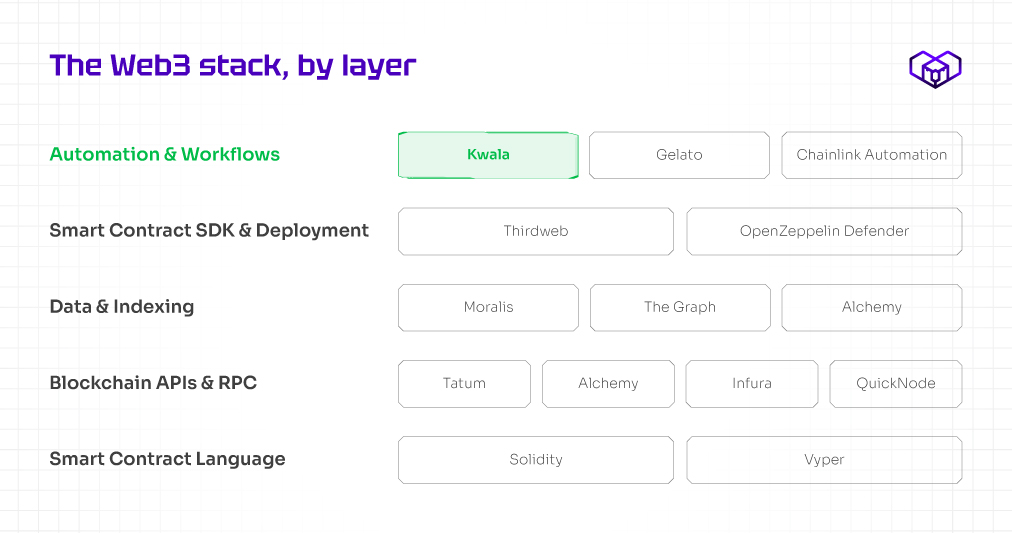
Before the individual comparisons, here’s the shape of the space. This is the frame everything else in this piece is built on.
| Stack layer | What it does | Primary tool |
| Automation & workflows | Listen to on-chain events, run conditional logic, trigger actions | Kwala, Gelato, Chainlink Automation |
| Smart contract SDK & deployment | Deploy contracts, manage them, provide frontend SDKs | Thirdweb, OpenZeppelin Defender |
| Data & indexing | Read on-chain state, index events, serve to frontend | Moralis, The Graph, Alchemy |
| Blockchain APIs & RPC | Talk to the chain, broadcast transactions, read blocks | Tatum, Alchemy, Infura, QuickNode |
| Smart contract language | Write the on-chain logic itself | Solidity, Vyper |
A few things to notice. First, some tools span multiple layers — Alchemy shows up in both data and RPC, Thirdweb has expanded into some data territory with Insight, Moralis has pieces of RPC. The layers are real, but the vendors don’t stay in their lanes. Second, Kwala’s layer is crowded if you include the real automation competitors: Gelato and Chainlink Automation. We’ll come back to them. Third, the reason you’re probably reading this piece is that nobody tells you which layer you need — they just tell you about their tool. So, you end up comparing a data platform to a workflow platform and wondering why the feature lists don’t match.
Here’s how to think about it: if the core thing you need is “something happens on-chain, and I need other things to happen in response,” you need automation. That’s Kwala’s layer. Everything else is a different problem.
With that frame established, the comparisons.
Kwala vs Moralis
Moralis is a Web3 data platform. Its core job is reading on-chain state — balances, NFTs, transaction history, token metadata — and serving it through clean APIs so your frontend doesn’t have to deal with RPC calls directly. It’s good at this. A lot of dApp frontends use Moralis for exactly this reason: the alternative is writing your own indexer, and writing your own indexer is a six-month project that nobody enjoys.
Where the confusion starts: Moralis also offers Streams, which watches on-chain activity and sends webhooks when something happens. On the surface, that sounds like Kwala. In practice, it isn’t.
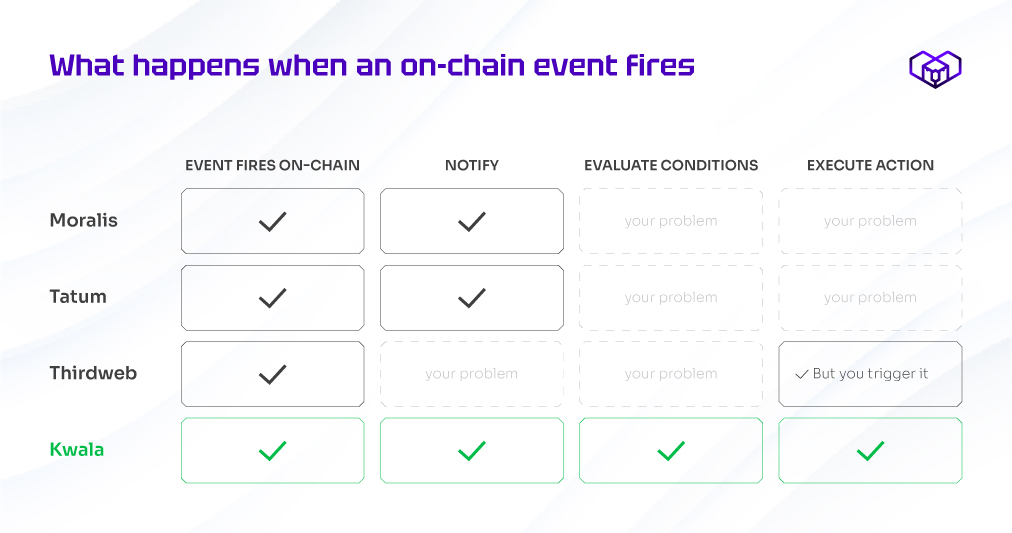
Moralis Streams notifies you that something happened. It doesn’t then do the next thing. If you want to react to the event — call another smart contract, post to Discord, trigger a cross-chain action — you need to build that logic yourself, in your own backend, with your own retry and failure handling. The Streams documentation is explicit about this: Streams “pushes on-chain activity to you the moment it happens,” with delivery handled by Moralis. What happens after that is your problem.
Kwala is the workflow engine. You define the trigger (an on-chain event), the conditions (what must be true for the workflow to fire), and the actions (what happens when it does — including on-chain transactions, cross-chain calls, and Web2 API calls). Kwala handles the execution, the retries, the finality checks, and the orchestration. You don’t need a backend in the middle.
When Moralis is the right answer:
Your primary need is reading on-chain data and serving it to a frontend. You want token balances, NFT metadata, and transaction history without building your own indexer.
When Kwala is the right answer:
Your primary need is reacting to on-chain events with logic that runs across chains, calls other contracts, or integrates with Web2 services — and you don’t want to maintain the backend for it.
When you need both:
You’re building a dApp that shows users their activity (Moralis for the frontend) and automates things in response to that activity (Kwala for the workflow). This is the common case for any non-trivial application.
Kwala vs Thirdweb
Thirdweb is a smart contract toolkit. Its core job is making it fast to deploy and manage contracts on EVM chains — pre-audited templates for NFTs, tokens, marketplaces, and so on, plus SDKs for integrating those contracts into frontends. If you’re launching an NFT collection this weekend, Thirdweb is probably how you do it without writing Solidity from scratch.
Thirdweb has expanded well beyond contract deployment. Over the past couple of years, they’ve added in-app wallets (Connect), payment bridging (Payments), on-chain data (Insight), and a transactions product originally called Engine (now rebranded as Transactions). Transactions is the piece that overlaps with Kwala’s space, so that’s where the comparison gets interesting.
Transactions is a backend service for executing blockchain transactions with features like nonce management, gas sponsorship, and automatic retries. It’s useful. It solves a real problem: sending transactions reliably from a server. But Transactions is a transaction primitive, not a workflow engine. You still must decide when to call it, based on what trigger, with what conditions. That decision-making logic — the “if this happens, then do that” layer — is what Kwala is.
Put differently: if you use Thirdweb Transactions, you still need something to tell it when to send transactions. In a lot of teams, that something is a custom backend service running event listeners. In a Kwala-based architecture, Kwala is that layer.
When Thirdweb is the right answer:
You’re deploying smart contracts, managing NFT collections, or building a dApp that needs strong wallet and SDK primitives. Thirdweb’s contracts library and Connect SDK are excellent for this.
When Kwala is the right answer:
You have the contracts deployed (with Thirdweb or otherwise) and now you need to orchestrate workflows around them — cross-chain actions, event-driven triggers, multi-step on-chain logic.
When you need both:
You use Thirdweb to ship the contracts and the frontend, and Kwala to automate what happens when users interact with them. These are genuinely complementary.
Kwala vs Tatum
Tatum is a blockchain APIs platform. Its core job is giving developers unified API access to a large set of blockchains — reading data, sending transactions, managing wallets — without needing to integrate with each chain’s native tooling individually. Per Tatum’s own documentation, they support 130+ chains including EVM chains, UTXO chains like Bitcoin and Litecoin, and emerging ecosystems. It’s the most general-purpose of the four tools we’re comparing.
The overlap with Kwala is narrower than the other comparisons. Tatum has a Notifications API that watches for on-chain activity and sends webhooks — similar in spirit to Moralis Streams. Same limitation applies: Tatum tells you something happened. Acting on it is your problem.
There’s a bigger architectural difference worth naming. Tatum’s core design is chain-agnostic breadth — the whole product exists to smooth over the differences between very different chain models (EVM, UTXO, and others) behind a unified API. That breadth is the feature and the constraint. Kwala supports EVM and non-EVM networks, but the depth of its abstractions is in the EVM layer — gas management, nonce ordering, ERC-4337 smart wallets, cross-chain messaging between L2s. If your application is EVM-focused and you care about those nuances, Kwala will feel more native. If your application spans EVM and UTXO chains and you want one unified API surface, Tatum is the better fit.
When Tatum is the right answer:
You’re building a multi-chain application that spans EVM and UTXO chains (Bitcoin, Litecoin, and similar) and you want one API to talk to all of them.
When Kwala is the right answer:
You’re EVM-focused (even if occasionally branching into non-EVM), you need workflow automation rather than just API access, and you care about the depth of the abstraction over the breadth.
When you need both:
Unusual. If your application is truly multi-chain in the Bitcoin-plus-Ethereum sense, Tatum is your infrastructure layer and Kwala is your EVM-side automation layer. In most real-world builds, teams pick one of the two based on which chain strategy they’re committed to.
What about Gelato and Chainlink Automation?
Fair question, and worth answering honestly: Gelato and Chainlink Automation are the tools that compete with Kwala in the automation layer. They don’t show up in the “Kwala vs Moralis” search because they occupy the same mental category as Kwala — most people searching that phrase are earlier in the evaluation, still figuring out what kind of tool they need. By the time you’re comparing Kwala to Gelato, you’ve already decided you need automation.
Quick version for readers who are further along:
Gelato is the most established automation network. Per their own site, Gelato infrastructure powers 500+ Web3 apps including MakerDAO, Beefy Finance, and Instadapp. Strong ecosystem integrations and a mature developer experience. Gelato’s Web3 Functions let you write automation logic in TypeScript, stored on IPFS and executed by Gelato nodes. Where Kwala wins is the YAML-based declarative workflow model and the built-in cross-chain orchestration. Where Gelato wins is ecosystem maturity — if you’re looking for social proof, Gelato has years of production deployments at major protocols.
Chainlink Automation (formerly Keepers) has the strongest decentralization story and the deepest cryptoeconomic security guarantees. It runs on the same node network that secures over $7 trillion in transaction value across other Chainlink services, with verifiable compute provided via OCR3 consensus. If your automation is security-critical in a way that needs oracle-network-level trust — think Aave liquidations — Chainlink is hard to beat. For most workflows — the “react to this event, call that contract, notify Discord” kind — the security model is overkill, and the integration surface is heavier than it needs to be.
We’ll write a full kwala-vs-Gelato and kwala-vs-Chainlink-Automation piece separately. They deserve their own treatment. For the reader who came in via “Kwala vs Moralis,” the short answer is: once you’ve decided you need automation, come back and compare Kwala to Gelato and Chainlink. Those are the relevant comparisons.
Feature matrix
Pulling it together into one table. This is the reference version — the nuance is in the prose above, but this is what you skim if you’re in a hurry.
| Feature | Kwala | Moralis | Thirdweb | Tatum |
| Primary job | Workflow automation | On-chain data & APIs | Contract deployment & SDKs | Multi-chain APIs |
| Stack layer | Automation | Data | Deployment / SDK | APIs / RPC |
| Event-driven triggers | Yes (native) | Yes (webhooks only, via Streams) | Partial (via Transactions) | Yes (webhooks only, via Notifications) |
| On-chain action execution | Yes (built in) | No | Via Transactions | No |
| Cross-chain workflows | Native | No | Limited | Limited |
| Web2 API calls from workflows | Native | No | No | No |
| No-backend deployment | Yes | Partial | Partial | No |
| EVM-focused or multi-chain | EVM deep + non-EVM | EVM + some non-EVM | EVM only | 130+ chains (EVM + UTXO + others) |
| ERC-4337 smart wallet | Native (workflows run through user’s own ERC-4337 wallet) | No | Yes | Limited |
| Pre-audited contract templates | No (not the job) | No | Yes | No |
| Managed RPC | Uses chain RPC | Yes | Yes | Yes |
| Typical reader | Eng lead building workflows | Frontend eng reading chain data | Dev shipping contracts fast | Eng team building multi-chain |
The row that matters most here: “on-chain action execution.“ Kwala is the only tool in this comparison whose primary job is executing on-chain actions in response to on-chain events, as a managed service. Moralis and Tatum notify you. Thirdweb, via Transactions, will send transactions — but you still must decide when. If you need something that closes the loop end-to-end, that’s what the automation layer is for. The workflow builder docs walk through what defining a trigger, conditions, and actions looks like — worth a look if you’ve gotten this far and the architecture makes sense to you.
Which one should you pick?
Rather than a ranking, here’s a decision framework. Answer the question your problem is most shaped like, and the right tool falls out.
“I need to show users their on-chain activity in my app.”
You need data infrastructure. Start with Moralis, or The Graph if you want more control over indexing. This is not a Kwala problem.
“I need to launch smart contracts and integrate them into a frontend.”
You need deployment tooling. Start with Thirdweb for the contracts and the SDK. If you’re later going to automate workflows around those contracts, that’s when Kwala enters the picture — but not first.
“I need API access to many chains, including non-EVM ones.”
You need a multi-chain API provider. Start with Tatum or, for EVM-only, Alchemy or Infura.
“Something happens on-chain, and I need other things to happen in response — reliably, across chains, without maintaining a backend.”
This is the Kwala problem. It’s also the Gelato and Chainlink Automation problem. Pick Kwala if you want declarative YAML workflows, native cross-chain orchestration, and built-in Web2 API calls. Pick Gelato if ecosystem maturity matters most. Pick Chainlink Automation if your workflow is security-critical in a way that needs oracle-network trust.
“I’m not sure yet.”
Then the answer is probably “you need at least two of these.” Most production Web3 teams end up with a data layer (Moralis or similar), a deployment layer (Thirdweb or similar), an automation layer (Kwala or similar), and an RPC layer (Alchemy or similar). These are not competing. They’re a stack.
Closing
The reason “Kwala vs Moralis” is a common search isn’t that these tools are interchangeable. It’s that the Web3 stack is young enough that nobody has drawn the map clearly, so teams end up comparing layers that don’t compete and getting confused about why the feature lists don’t line up.
The layer you need is determined by the problem you’re trying to solve, not by the vendor’s category. If your problem is “react to on-chain events with logic that executes actions across chains,” you need automation. Kwala, Gelato, and Chainlink Automation are the three serious options in that layer. Moralis, Thirdweb, and Tatum are solving different problems — good problems, real problems, but not this one.
Pick the layer first. The vendor second. That’s the order that saves you the rewrite at month six.
If you’ve decided the automation layer is the layer you need, start with the kwala docs or book a 20-minute walkthrough with the team.
FAQs:
Is kwala a replacement for Moralis?
No. Moralis reads on-chain data and serves it to your frontend through APIs — token balances, NFT metadata, transaction history. Kwala reacts to on-chain events and executes workflows in response. They sit at different layers of the stack, and most production dApps that use one would benefit from also using the other. If you’re choosing between them, you’ve probably misidentified the problem you’re solving.
Can I use kwala and Thirdweb together?
Yes — and most teams that use both do exactly that. Thirdweb is the strongest tool for deploying smart contracts and building frontends with wallet integrations. Kwala is the workflow layer that runs on top of those deployed contracts: triggering actions when events fire, orchestrating cross-chain logic, calling Web2 APIs. Thirdweb gets your contracts live; kwala automates what happens once they’re being used.
What’s the difference between kwala and Gelato?
Both are Web3 automation platforms. The main differences are the developer model and the orchestration depth. Kwala uses declarative YAML to define workflows — you describe triggers, conditions, and actions, and the platform handles execution. Gelato’s Web3 Functions are TypeScript-based, stored on IPFS, run by Gelato’s node network. Kwala has native cross-chain workflow orchestration; Gelato has more years of production deployments and a larger ecosystem of integrations. Pick based on whether you value the declarative model or the ecosystem maturity.
Does kwala support non-EVM chains?
Yes. Kwala supports EVM and non-EVM networks. That said, the depth of kwala’s abstractions — gas management, nonce ordering, ERC-4337 smart wallets, cross-chain messaging — is built primarily for the EVM ecosystem. If you’re EVM-focused with occasional non-EVM needs, kwala fits well. If your application is fundamentally multi-chain across very different chain models (Bitcoin and Ethereum, for example), Tatum’s chain-agnostic API surface is probably a better foundation.
Which is better for DeFi automation — kwala or Chainlink?
Depends on what kind of DeFi automation. For security-critical workflows that need oracle-network-level trust — the canonical example is Aave’s liquidation engine — Chainlink Automation is the right call. The cryptoeconomic security and OCR3 consensus model is hard to match for workflows where wrong execution means real losses. For everything else — DAO treasury automation, reward distribution, vault rebalancing, dynamic NFT logic, cross-chain triggers — kwala’s lighter-weight workflow model is faster to ship and easier to iterate on. The honest framing: Chainlink Automation for the workflows where you’d lose sleep over a node failure; kwala for the workflows where you wouldn’t.
Do I need a backend to use kwala?
No. That’s the design point. Triggers, conditions, and actions are all defined in the workflow itself. Kwala handles execution, retries, finality checks, and orchestration. There’s no server to provision, no event listener to maintain, no retry logic to write. You write your smart contracts, you write your frontend, and the workflow layer in the middle is kwala — defined declaratively, not operationally.