
 book a call with us
You know that moment when you’re refreshing a blockchain explorer and look away for just one minute? That’s usually when the block you’ve been waiting for gets mined. It often leads to missed rewards, failed bids, or poorly timed actions. That’s the reality of Web3, where everything happens instantly on-chain with zero patience for human timing. Tracking block numbers manually, checking explorers, or […]
Read MoreBuilding a dApp used to mean managing servers, writing custom event listeners, and stitching together off-chain cron jobs. Most teams spend more time on infrastructure than on the product itself. That is a real problem, and it is one the industry has not solved well.
Web3 workflow automation changes this. Instead of wiring up backend plumbing manually, you define a workflow that handles everything for you. As a result, your team ships faster, operates more reliably, and keeps smart contract logic where it belongs: on-chain.
This guide covers everything you need. You will learn what web3 workflow automation is, why it matters, what to look for in a platform, and how Kwala approaches the problem differently from anything else in the market.
1. What Is Web3 Workflow Automation?
Web3 workflow automation is the practice of defining, orchestrating, and executing sequences of blockchain and off-chain actions through programmable workflows. Crucially, it does this without requiring you to manage backend infrastructure manually.
In traditional dApp development, a backend requires servers, databases, private key managers, event pollers, retry logic, and monitoring. Each layer adds cost, complexity, and a new failure surface. However, with a workflow-based approach, you replace that entire stack with declarative logic that runs automatically in response to on-chain events, price triggers, or time conditions.
“Web3 workflow automation replaces manual backend infrastructure with programmable on-chain logic that executes automatically, without servers.”
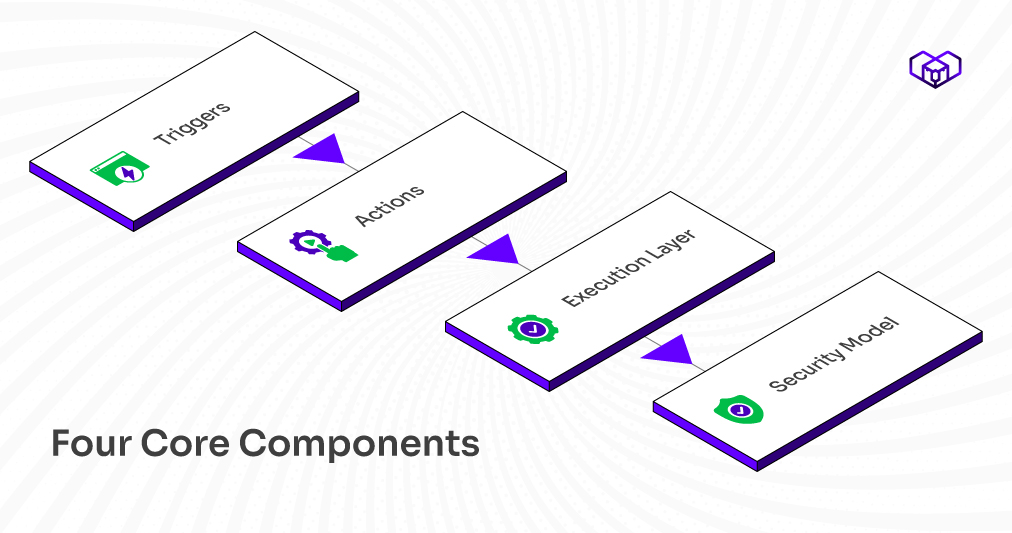
A blockchain workflow automation system typically includes four core components:
- Triggers: conditions that start a workflow. Examples include a token price crossing a threshold, a wallet receiving funds, or a smart contract emitting a specific event.
- Actions: the steps that execute when a trigger fires. These include contract function calls, transaction execution, and Web2 API requests.
- Execution layer: the infrastructure that runs workflows reliably, handles retries, and guarantees delivery even during network congestion.
- Security model: the mechanism that ensures only authorized workflows can act on behalf of a user or protocol.
Onchain workflow automation takes this one step further. In this model, the security and authorization logic lives inside a smart contract, not on a centralized server. Therefore, every action is cryptographically verified before it executes. This removes a major trust assumption present in most Web2-style automation tools.
In practice, this distinction matters more than it might appear. For example, a platform that processes your transactions through a centralized relay can be censored, hacked, or shut down. An onchain model, in contrast, is resilient to all three scenarios because the authorization logic runs directly on the chain. As blockchain adoption grows, this architectural choice will increasingly separate production-grade infrastructure from tools that merely appear serverless on the surface.
2. Benefits of Web3 Workflow Automation
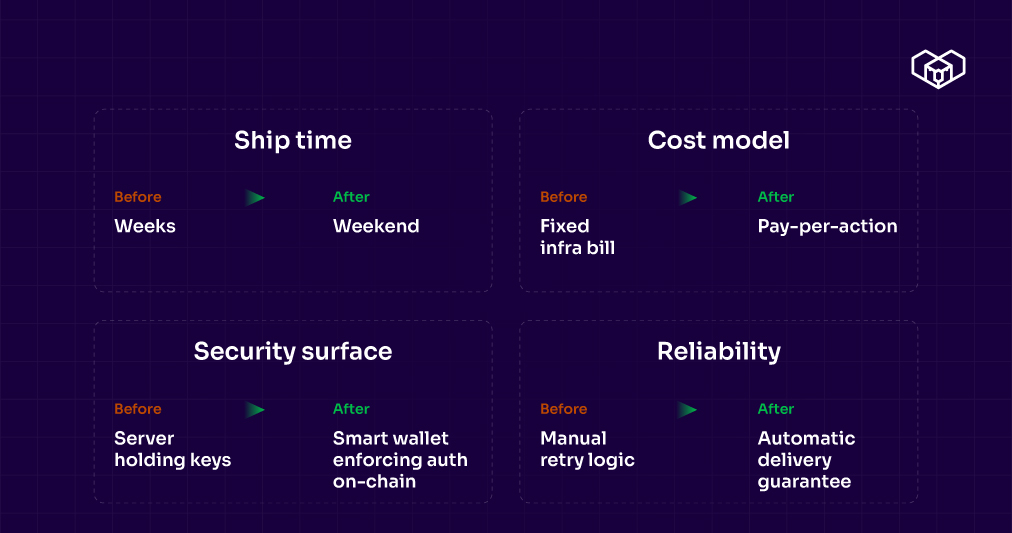
Developers who adopt a web3 automation protocol consistently report improvement across four key areas. Each benefit compounds over time as the protocol scales.
Faster Time to Production
Setting up a production-grade dApp backend can take weeks. In contrast, a workflow platform gives you pre-built primitives from day one: wallet management, transaction execution, and event listeners. As a result, teams that previously spent weeks on infrastructure can ship a working product in a weekend.
Moreover, when smart contract logic changes, you update the workflow rather than rewriting backend services. This makes iteration dramatically faster and far less risky.
Lower Infrastructure Costs
Running your own servers, node infrastructure, and key management is expensive. Additionally, it requires dedicated DevOps resources to maintain year-round. A serverless workflow platform eliminates those costs entirely. You pay per action, not for idle compute.
For early-stage projects, this is a significant cost advantage. Furthermore, for high-volume protocols, it removes a cost that scales with usage rather than with the value you actually deliver.
Stronger Security Posture
Private key management is the most dangerous part of most dApp backends. However, with an onchain workflow automation model built on ERC-4337 smart wallets, there are no private keys to store on a server. The smart wallet contract itself enforces who can trigger what actions, and under what conditions.
Consequently, the attack surface shrinks considerably. There is no server holding signing material. There is no centralized point of failure. Every action passes through cryptographically verified authorization logic before it executes.
Operational Reliability
Blockchains are not always predictable. Gas prices spike, transactions get stuck, and RPC connections drop without warning. Nevertheless, a purpose-built blockchain workflow automation layer handles all of this automatically. It retries failed transactions, manages gas estimation, and guarantees eventual execution.
In addition, because workflows are stateless and declarative, they are far easier to audit, test, and reason about than imperative backend code. This makes debugging and compliance reporting significantly more straightforward.
Real-World Use Cases for Web3 Workflow Automation
Understanding the theory is one thing. Seeing concrete examples, however, makes it easier to map the technology to your own product. Here are four use cases where teams are using web3 workflow automation in production today.
DeFi Liquidation and Rebalancing
Lending protocols need to liquidate undercollateralized positions the moment a threshold is breached. With onchain workflow automation, you set a token price trigger tied to an oracle feed. When the condition is met, the workflow fires the liquidation transaction immediately and automatically. Additionally, the transaction manager ensures the transaction lands even if gas prices spike during periods of high volatility.
Multi-Chain dApp Launches
Deploying a dApp across five EVM chains manually means five separate deployment scripts, five sets of configuration, and five potential sources of error. With blockchain workflow automation, in contrast, you define the deployment once and the Contract Deployer handles execution across all target chains in a single workflow run. As a result, launch timelines shrink from days to hours.
Treasury Monitoring and On-Chain Notifications
DAOs and protocols frequently need real-time visibility into treasury wallet activity. A Wallet Tracker workflow monitors the designated address continuously. When a transaction exceeds a defined threshold, the Web2 API Engine sends a notification to a Telegram channel or Discord server. Consequently, treasury managers receive alerts without writing a single line of backend code or running a server overnight.
Payment Processing and Token Gating
Consumer dApps that require token-gated access need a reliable way to verify on-chain state and respond in real time. An Event Listener workflow captures the relevant token transfer event, then calls a Web2 API to grant or revoke access in the application layer. Therefore, the entire access control loop runs automatically without a backend service managing session state.
3. How to Evaluate a Web3 Workflow Automation Platform
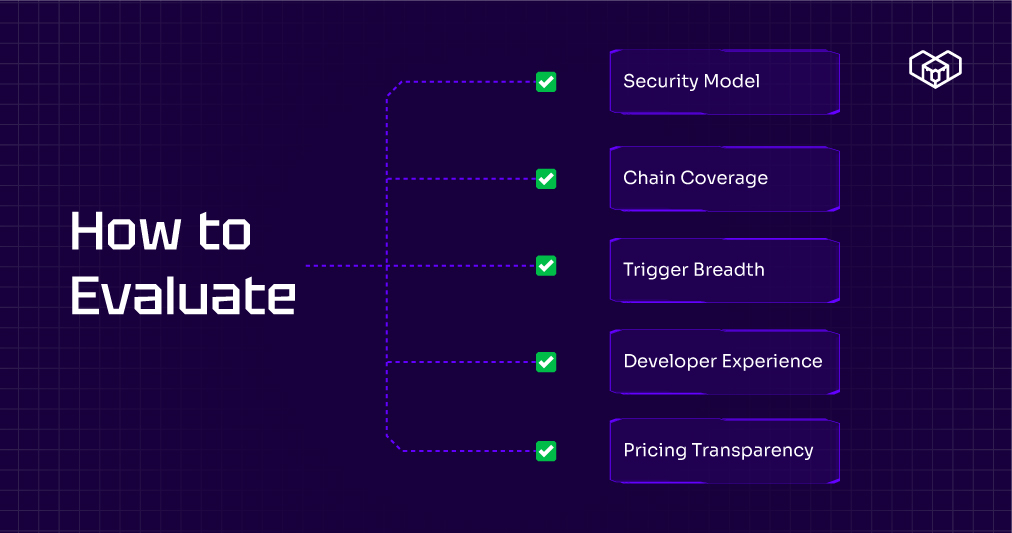
The category is growing quickly. Therefore, evaluating platforms against the right criteria is essential. Look beyond feature lists to architecture, security model, and long-term fit for your team.
Security Model: Where Does Trust Live?
This is the most important question to ask any vendor. Find out whether the platform holds private keys on your behalf. If the answer is yes, you have introduced a centralized trust assumption that fundamentally conflicts with the Web3 security model.
In contrast, look for platforms that use ERC-4337 account abstraction. In this model, the smart wallet contract controls authorization. The platform acts as a bundler and operator. However, it cannot move funds or trigger actions without on-chain approval from your contract.
Chain Coverage and Compatibility
Your chain requirements will evolve over time. Consequently, evaluate whether the platform supports the chains you need today and the ones you are likely to need in the next 12 months. Check whether it supports all major EVM-compatible chains natively, or whether it locks you into a proprietary network.
For example, if you are building a DeFi protocol across Ethereum, Arbitrum, and Polygon, you need a platform that treats all three as first-class environments, not afterthoughts.
Trigger Breadth and Composability
A mature web3 automation protocol supports all common trigger types: on-chain events, wallet balance changes, token price thresholds, and time-based schedules. Moreover, it allows you to compose multiple triggers and actions into a single multi-step workflow without custom glue code.
Pay close attention to event listener reliability. A platform that drops events under load or during RPC instability will cause production problems. Therefore, stress-test this explicitly before committing.
Developer Experience
Automation tooling is only valuable if teams actually adopt it. Evaluate the workflow definition interface: is it a visual builder, a YAML or DSL syntax, or raw SDK calls? Check whether it integrates with your existing CI/CD pipeline and supports local testing before deployment to mainnet.
Furthermore, review documentation quality, the availability of example workflows, and how actively the platform team responds to questions. These details predict long-term support quality far better than marketing materials.
Pricing Transparency
Usage-based pricing is standard in this category. However, the details matter significantly. Understand exactly what constitutes a billable action, how retry attempts are counted, and whether monthly minimums apply. Additionally, verify that the free tier is genuinely useful for development, and not artificially limited to force quick upgrades.
4. Kwala’s Approach to Web3 Workflow Automation
Kwala is a programmable Web3 backend platform built specifically for EVM development. It reimagines the dApp backend as a set of composable workflow building blocks. As a result, you eliminate the need for servers, private key managers, and custom backend services entirely.
“Frontend stays thin. Servers disappear. Your Kwala workflows become the backend.”
Seven Building Blocks
Kwala provides seven core primitives that cover the full backend surface of a typical dApp. Together, they give you everything needed to automate complex on-chain and off-chain workflows from a single platform:
- Smart Wallets: ERC-4337 programmable wallets with no private key handling required. Kwala manages execution while users retain full on-chain control.
- Transaction Manager: Execute, retry, and finalize transactions with delivery guarantees across any supported EVM chain, regardless of network conditions.
- Contract Deployer: Deploy smart contracts to multiple chains from a single automated workflow definition, with no per-chain setup required.
- Wallet Trackers: Monitor any wallet or smart contract address for state changes in real time, 24 hours a day, across all supported chains.
- Token Price Triggers: Fire actions automatically the moment a token crosses a defined price level on any supported oracle feed.
- Event Listeners: Persistent, always-on blockchain event listeners running simultaneously across every supported chain.
- Web2 API Engine: Call any external Web2 API directly from within a blockchain workflow, connecting on-chain logic to off-chain systems without custom middleware.
Together, these building blocks allow you to compose complex onchain workflow automation without writing backend code. For example, a DeFi protocol can use Kwala to monitor wallet positions, fire a liquidation transaction when a threshold is crossed, log the result to an external database via the Web2 API engine, and send a Telegram notification. All of this runs inside a single declarative workflow definition.
Security Architecture
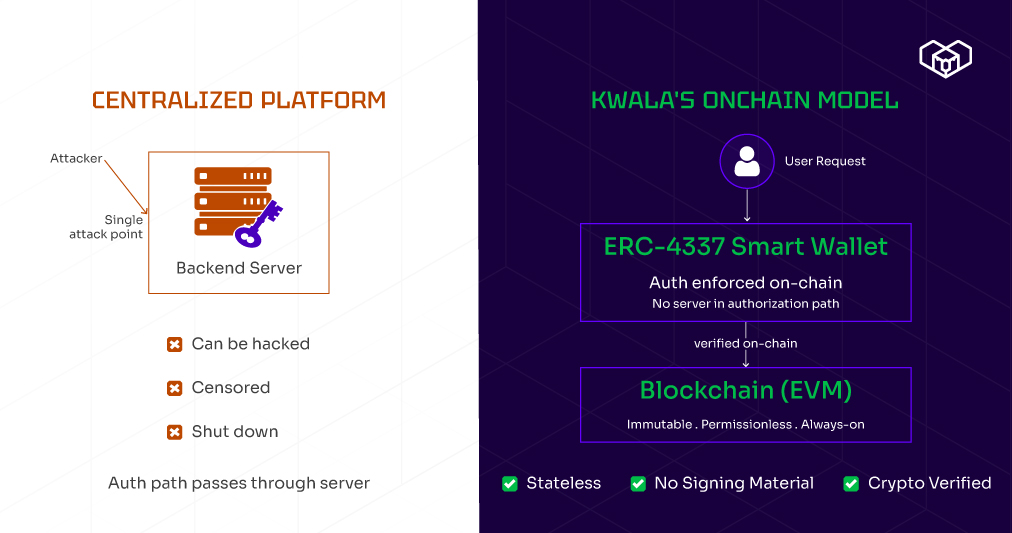
Kwala is stateless by design. It never stores private keys, signing material, or user data. Instead, every workflow runs through the user’s own ERC-4337 smart wallet, which enforces authorization on-chain, not on a server.
Kwala acts strictly as a bundler and operator. As a result, it cannot move funds or trigger actions without explicit on-chain authorization from your smart wallet contract. This is a meaningful architectural distinction. Most competing platforms hold keys centrally, which introduces a trust assumption Kwala deliberately avoids.
Chain Support
Kwala supports all major EVM-compatible chains: Ethereum, BNB Chain, Polygon PoS and zkEVM, Avalanche, Fantom, Base, Optimism, Arbitrum One, Arbitrum Nova, and Celo. The platform runs on Kwala’s decentralized infrastructure — a distributed layer that handles serverless execution across all supported chains simultaneously.
Workflow Syntax: Kwalang
Workflows are defined using Kwalang, a YAML-based declarative syntax designed specifically for EVM interactions. This means you can version-control your workflows alongside your smart contracts, integrate them into CI/CD pipelines, and review changes through standard pull request workflows. No proprietary tooling required.
Furthermore, when your smart contract logic changes, you update the workflow definition rather than a backend service. This keeps your architecture clean and your iteration cycle short. Most teams go from workflow concept to live deployment in a single session.
5. Frequently Asked Questions
What is web3 workflow automation?
Web3 workflow automation is a method of orchestrating blockchain and off-chain actions through programmable workflows, without managing backend infrastructure manually. It replaces servers, event pollers, and retry logic with declarative definitions that execute automatically in response to on-chain or off-chain triggers.
How is blockchain workflow automation different from traditional automation?
Traditional automation tools like Zapier or Make operate entirely off-chain. They connect Web2 APIs but have no native understanding of on-chain state, transaction execution, or smart contract interaction. Blockchain workflow automation is built specifically for the Web3 execution environment. It handles gas management, transaction retries, on-chain event listening, and smart wallet authorization. None of these are possible with standard Web2 automation tools.
What is a web3 automation protocol?
A web3 automation protocol is a standardized set of rules and infrastructure components that allow developers to define, trigger, and execute automated actions on a blockchain. It typically includes an execution layer using account abstraction such as ERC-4337, a trigger system for on-chain and off-chain events, and a security model that determines what is authorized to act on-chain on behalf of a user.
Is onchain workflow automation secure?
It depends on the architecture. Platforms that store private keys centrally introduce significant risk. However, onchain workflow automation systems built on ERC-4337 smart wallets are substantially more secure. In this model, authorization is enforced by the smart contract, not by a server. Kwala follows this model: it is fully stateless and never holds signing material.
What trigger types are supported?
Most mature platforms support four trigger types: on-chain events from smart contracts, wallet state changes such as balance updates or token transfers, token price conditions from oracle feeds, and time-based schedules. Kwala supports all four, and additionally allows you to compose multiple triggers into multi-step workflows.
How quickly can I start with a web3 workflow platform?
With Kwala, you can have your first workflow running in minutes. Pre-built building blocks cover the most common dApp backend tasks out of the box. As a result, most teams go from zero to a live workflow on a supported EVM chain within a single working session, without any server setup or infrastructure management.
Do I need to write backend code?
No. Kwala workflows are defined using Kwalang, a YAML-based declarative syntax. You do not need to write backend services, run your own node infrastructure, or manage private keys. A basic understanding of EVM concepts is helpful, but deep backend engineering experience is not required.
What is the difference between a web3 automation protocol and a smart contract?
A smart contract defines rules and state on-chain, but it cannot act autonomously in response to external conditions. A web3 automation protocol, in contrast, is the layer that watches for those conditions and triggers the smart contract when they are met. In other words, the smart contract is the logic and the automation protocol is the trigger mechanism. Together, they form a complete automated system. Without the automation layer, someone still has to call the contract manually, which defeats the purpose of automation.
Can web3 workflow automation work with Web2 systems?
Yes. This is one of the most underappreciated capabilities of modern blockchain workflow automation platforms. Kwala includes a Web2 API Engine that allows workflows to call any HTTP endpoint directly from within a workflow. As a result, you can connect on-chain events to off-chain systems like CRMs, analytics platforms, notification services, and databases without writing custom backend middleware. This is essential for building consumer-grade dApps that need to bridge the gap between on-chain state and off-chain user experiences.
Final Thoughts
Web3 workflow automation is not a nice-to-have for serious dApp teams. It is the difference between spending weeks on infrastructure and shipping a production-grade product in a weekend.
However, not all platforms are equal. The security model is the deciding factor. Look for a platform that does not hold your private keys, supports all the EVM chains you need, and provides composability for complex workflows without custom backend code.
Kwala is purpose-built for exactly this. It combines seven core EVM primitives, a stateless zero-trust security architecture, and a declarative YAML workflow syntax. The frontend stays thin. The backend disappears completely.
Ready to build your first workflow? Visit kwala.network and ship your first workflow today.