
 book a call with us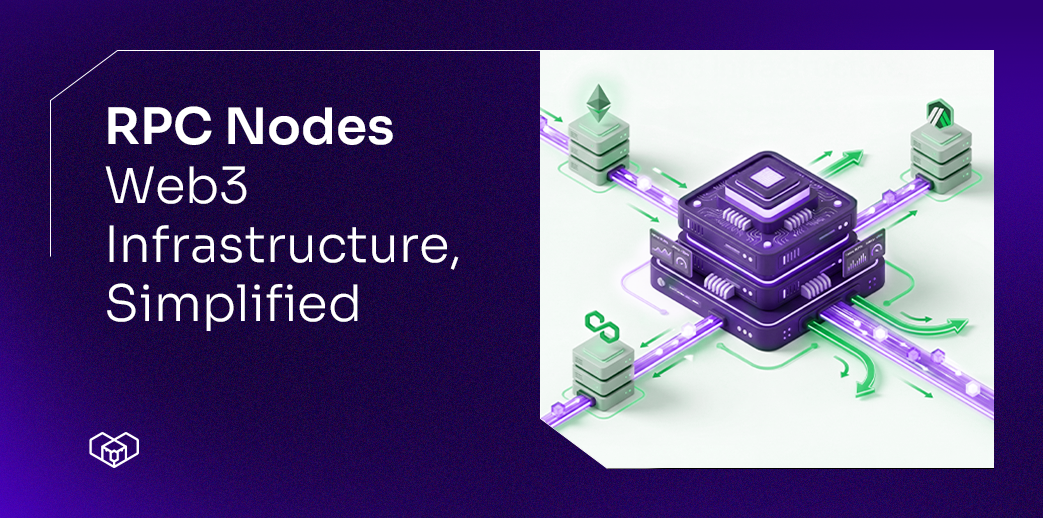
RPC nodes Web3 infrastructure becomes your problem the moment you scale. Most teams don’t notice it during testnet development, but once traffic increases, rate limits, latency, and node reliability start impacting real users. This is for Web3 teams scaling from MVP to production. The core problem isn’t smart contracts, it’s RPC infrastructure reliability. Once real traffic hits, rate limits, sync issues, and latency turn RPC nodes Web3 […]
Read MoreWhat happens when a governance vote needs to close at exactly midnight UTC, but nobody is awake to call the function?
This question highlights a fundamental limitation that blockchain developers have wrestled with since the launch of smart contracts. Blockchains are reactive by nature they process transactions when someone submits them, not when a clock strikes a certain hour. Yet so many real-world processes depend on time: subscription renewals, scheduled payments, proposal deadlines, reward distributions.
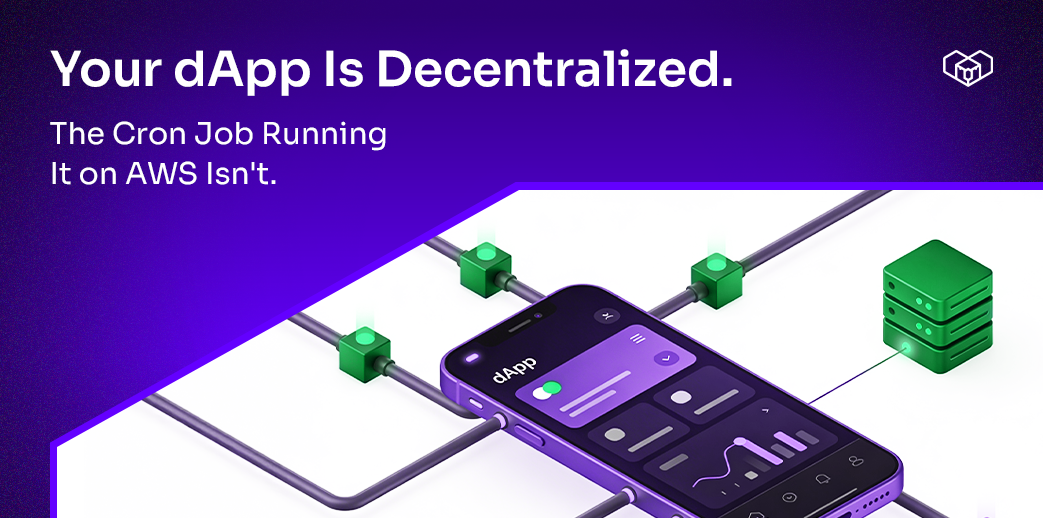
For most of blockchain history, the answer involved centralized workarounds. You ran a server with a cron job that submitted transactions at scheduled times. You trusted that server to stay online, maintain funds for gas, and execute reliably every single time. The decentralized application depended entirely on centralized infrastructure for anything time-sensitive a contradiction that undermined the core value proposition of building on-chain in the first place.
That tension is finally resolving. Scheduled transactions are becoming a native pattern on EVM networks, and the implications for how protocols are built and operated are significant.
Why Time-Based Execution Matters for Blockchain Applications
Consider how many business processes depend on timing rather than events. Payroll runs on the 15th and 30th. Insurance premiums are due monthly. Subscriptions renew annually. Governance periods last exactly seven days. None of these care about market conditions or user actions — they simply need to happen when the calendar says so.
Traditional EVM automation approaches forced developers to build this timing logic entirely off-chain. You could not tell a smart contract to execute next Tuesday because no mechanism existed to wake it up when Tuesday arrived. The contract sat there, waiting for someone to submit a transaction which meant someone had to remember to submit it, maintain the infrastructure to do so, and ensure nothing failed in the gap between the scheduled time and the actual execution.
This created compounding operational risk. If your server went down during a critical governance close, the proposal stayed open past its deadline. If gas prices spiked during your scheduled treasury distribution, the transaction failed or executed at unexpected cost. If the engineer responsible changed jobs, the institutional knowledge of which cron job ran when walked out the door with them. Every time-based process became a single point of failure wrapped in decentralized clothing.
The shift toward native scheduling changes this equation. When time-based triggers become part of the automation layer rather than a separate infrastructure responsibility, applications can schedule future execution without depending on centralized systems to remember and act. The protocol’s operational reliability stops being a function of your server uptime and starts being a function of the automation platform’s execution network.
Kwala’s time-based workflow configuration directly addresses this gap. You define the operation, specify when it should execute, and the platform handles submission when that moment arrives with execution logging that gives you the audit trail to confirm every scheduled operation ran as configured.
Where Scheduled Blockchain Transactions Deliver the Most Value
Blockchain scheduling is finding natural homes across several categories of protocol operations. The clearest way to identify your own automation candidates is to audit which operations currently require someone on your team to initiate them manually on a schedule.
Recurring On-Chain Payments and Subscription Processing
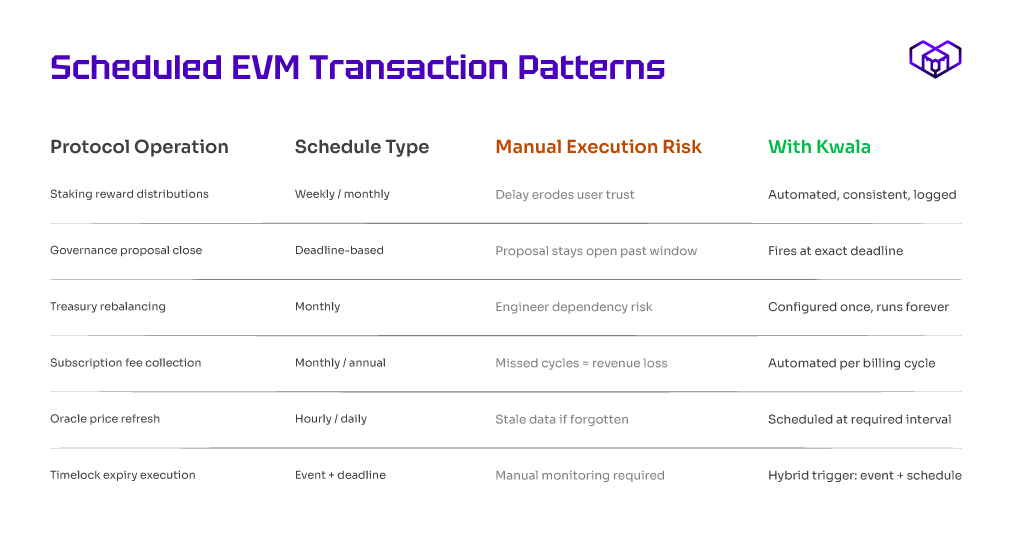
Subscription models on-chain require periodic processing that does not depend on user action — collecting protocol fees, distributing staking rewards, renewing access credentials, or processing recurring payments for protocol services. These operations need to execute at regular intervals regardless of what else is happening on-chain.
Without scheduled automation, someone must initiate each cycle manually. This introduces execution dependency on individuals, creates inconsistency in timing that users notice, and generates unnecessary operational overhead for what should be a fully automated process. Protocols building automated subscription payment workflows eliminate this overhead by configuring the recurring schedule once and letting execution run automatically every cycle with credits charged only when the workflow actually fires.
Governance Cycle and Voting Period Management
DAOs and governance systems depend heavily on timing precision. Proposal periods have fixed durations that must be enforced consistently. Voting windows open and close on schedule. Execution timelocks must expire before changes take effect. When any of these stage transitions require manual execution, your governance process has a coordination dependency that introduces delay, inconsistency, and the possibility that a stage simply doesn’t advance because nobody was available to trigger it.
Scheduled automation ensures governance processes proceed without requiring manual intervention at each stage. Combined with event-based triggers that detect when proposals reach quorum, you can build fully autonomous governance lifecycle management with human attention focused on the substantive voting decisions rather than the procedural function calls.
Treasury and Financial Operations
Periodic treasury distributions, yield harvesting, and portfolio rebalancing all benefit from scheduled execution. These are often the highest-value operations in a protocol’s operational stack and the ones where manual execution failures carry the greatest consequence.
A treasury distribution that executes twelve hours late because of a missed calendar reminder is not just an operational inconvenience. For users watching on-chain activity, unexplained delays in expected distributions create uncertainty about protocol health. Scheduled automation makes these operations as predictable as a bank’s wire transfer schedule users know when distributions happen because they happen at the same time, every time.
How Time-Based Scheduling Works on EVM Networks
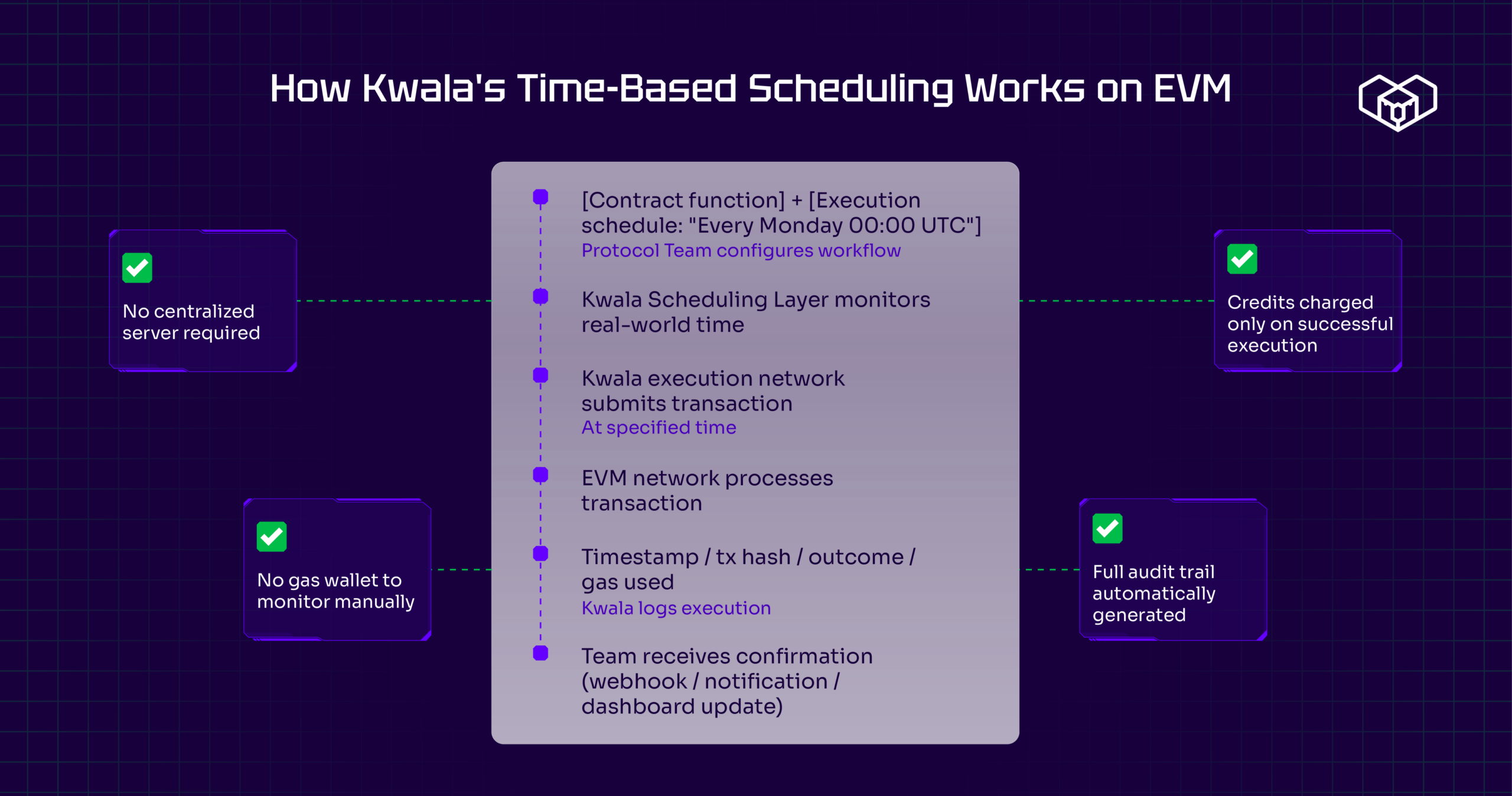
The mechanics of scheduled transactions vary across implementations, but the core concept is consistent: you define what should happen, specify when it should happen, and the automation layer handles execution when that time arrives.
It is worth understanding why this is technically non-trivial on EVM networks. Smart contracts have no internal clock they cannot initiate their own execution. The EVM processes transactions as they arrive; there is no scheduler embedded in the protocol itself. Time-based execution therefore requires an external layer that monitors real-world time and submits the appropriate transaction at the right moment.
This is exactly the gap that blockchain automation platforms fill and where the architecture of that external layer matters significantly for reliability.
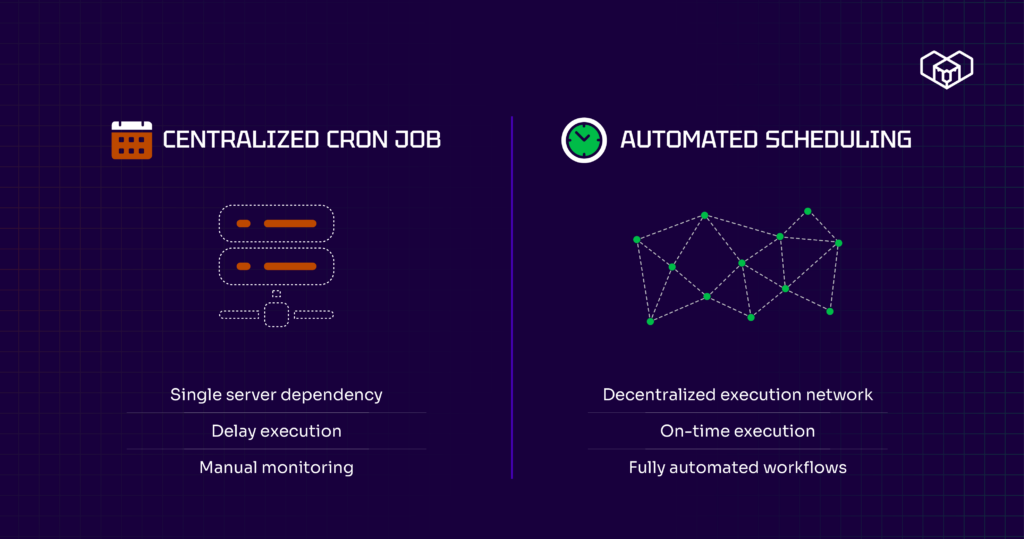
Kwala’s time-based triggers work as a complement to its event-based system. You configure a workflow with a specific execution time or recurring schedule daily, weekly, monthly, or at a precise UTC timestamp and the platform submits the transaction when that moment arrives. The key architectural differences from a traditional cron job approach:
Decentralized execution removes the single point of failure that a centralized server introduces. Kwala’s execution network operates across distributed nodes rather than a single infrastructure provider, meaning no individual server going offline prevents your scheduled transaction from executing.
Credit-based payment means you only pay when execution actually happens — not for idle server time between scheduled operations. During quiet periods between cycles, you are not paying for infrastructure that is simply waiting.
Integrated execution logging provides timestamped confirmation of every scheduled operation — what ran, when it ran, and what the outcome was. This audit trail is operationally useful and, for protocols with compliance requirements, may be necessary documentation.
Unified platform for both time-based and event-based automation means your team manages one workflow system rather than maintaining separate infrastructure for scheduled operations and event-driven responses.
Understanding how this integrates with event-based triggers shows why the combined approach is more powerful than either pattern alone.
Combining Scheduled and Event-Based Automation on EVM
The most sophisticated EVM automation implementations combine both scheduling and event response because most production protocols need both, and choosing one pattern means your automation has blind spots.
Think about a DeFi lending protocol’s full operational picture. Event triggers handle liquidations when collateral ratios drop below thresholds responding instantly to market movements that cannot wait for a scheduled check. But scheduled triggers handle the daily interest accrual, the weekly fee distributions, and the monthly governance cycles that need to run on time regardless of market conditions. Neither pattern alone covers all operational needs.
The same applies to governance systems. A time-based trigger fires when a proposal period expires closing the vote on schedule. An event-based trigger fires when a proposal reaches quorum before its deadline allowing early execution without waiting for the deadline. Neither trigger alone handles both scenarios. Together, they create a governance system that is both time-aware and event-responsive.
The three-component framework for hybrid automation:
Reactive components respond to on-chain events as they happen — transfer confirmations, threshold breaches, state changes, function calls.
Proactive components execute scheduled operations regardless of external conditions — recurring distributions, governance deadlines, maintenance windows, subscription cycles.
Conditional logic determines which response applies in any given situation — filtering noise, evaluating context, routing to the appropriate action based on the full state of the system at the moment of execution.
Kwala supports all three components within a single workflow platform. You configure event triggers and time triggers through the same interface, with the same conditional logic layer applied to both. [Teams building full workflow automation for dApps] typically start with event-based monitoring, add scheduled operations as their protocol matures, and progressively build the hybrid architecture that production-grade protocols require.
Getting Started With Scheduled Transactions on EVM
If you are evaluating scheduled blockchain execution for your protocol, the starting point is a manual process audit specific to your operational stack not a generic checklist.
For EVM protocols, the highest-value scheduling candidates are typically identifiable by asking one question about each recurring operation: if the engineer responsible for initiating this left the company tomorrow, how long before something broke? Any operation where the answer is “within one cycle” is an immediate automation candidate.
In practice, this audit surfaces five to eight candidates for most protocols. Start with the highest-frequency operation the one that recurs most often and produces the most predictable output. Configure that workflow first. Verify execution against testnet deployments before moving to mainnet. Then expand to additional scheduled operations using the same configuration pattern.
Consider your execution timing requirements carefully. Blockchain timing is not perfectly precise scheduled transactions execute at or shortly after the specified time, typically within seconds to minutes depending on network conditions and block times. For operations that tolerate small timing windows (treasury distributions, reward cycles), this precision is entirely sufficient. For operations requiring tighter timing (certain arbitrage or liquidation scenarios), pair scheduled triggers with event-based monitoring to catch conditions that arise between scheduled checks.
The combination of event-driven and time-based automation creates protocols that handle both reactive and scheduled operations reliably reducing the operational burden that has traditionally accompanied blockchain development and eliminating the centralized infrastructure dependencies that contradict the decentralization promise.
Automate Your EVM Scheduling with Kwala
The operational contradiction at the heart of early blockchain development decentralized applications depending on centralized servers for time-sensitive execution is now solvable without custom infrastructure. Time-based triggers, combined with event-driven automation and conditional logic, give EVM protocols the complete operational automation layer that production applications require.
Kwala provides unified scheduling and event automation across EVM chains one platform, one workflow configuration system, one execution layer that handles both what happens and when it happens.
Explore Kwala’s time-based and event-driven automation workflows
Frequently Asked Questions: Scheduled Transactions on EVM Networks
Can Scheduled EVM Transactions Execute at Exact Times?
Blockchain timing is not perfectly precise due to block times and network conditions. Scheduled transactions execute at or shortly after the specified time typically within seconds to minutes depending on the network and current gas conditions. For most protocol operations (governance closes, reward distributions, treasury operations), this timing window is entirely acceptable. For operations requiring tighter precision, consider pairing scheduled triggers with event-based monitoring to catch conditions that arise between scheduled execution windows.
How Does Kwala Fund Scheduled Transactions for Gas?
Kwala uses a credit-based system. You pre-fund credits that cover execution costs, and the platform draws from that balance when scheduled transactions execute. This eliminates the need to maintain funded gas wallets across multiple chains or monitor wallet balances for each scheduled operation. Credits are charged only when a workflow executes successfully you pay for automation that runs, not for infrastructure that waits between cycles.
What Happens If Network Congestion Delays a Scheduled Transaction?
Kwala’s execution layer handles congestion by retrying scheduled transactions and adjusting gas parameters based on network conditions. You can configure maximum gas price limits or fallback behaviors for congested conditions. For operations where timing is critical, Kwala provides execution status notifications so your team is aware of any delay and can make informed decisions about manual intervention if the timing window is critical enough to warrant it.
Can I Use Both Scheduled and Event-Based Triggers in the Same Kwala Workflow?
Yes. Kwala supports hybrid workflows that combine time-based scheduling and event-driven triggers within the same workflow configuration. This is the recommended approach for protocols whose operations depend on both scheduled execution and reactive responses governance systems, lending protocols, and treasury management applications all benefit from the combined architecture.